Answer first
A useful study keeps exposure and cattle evidence on one clock
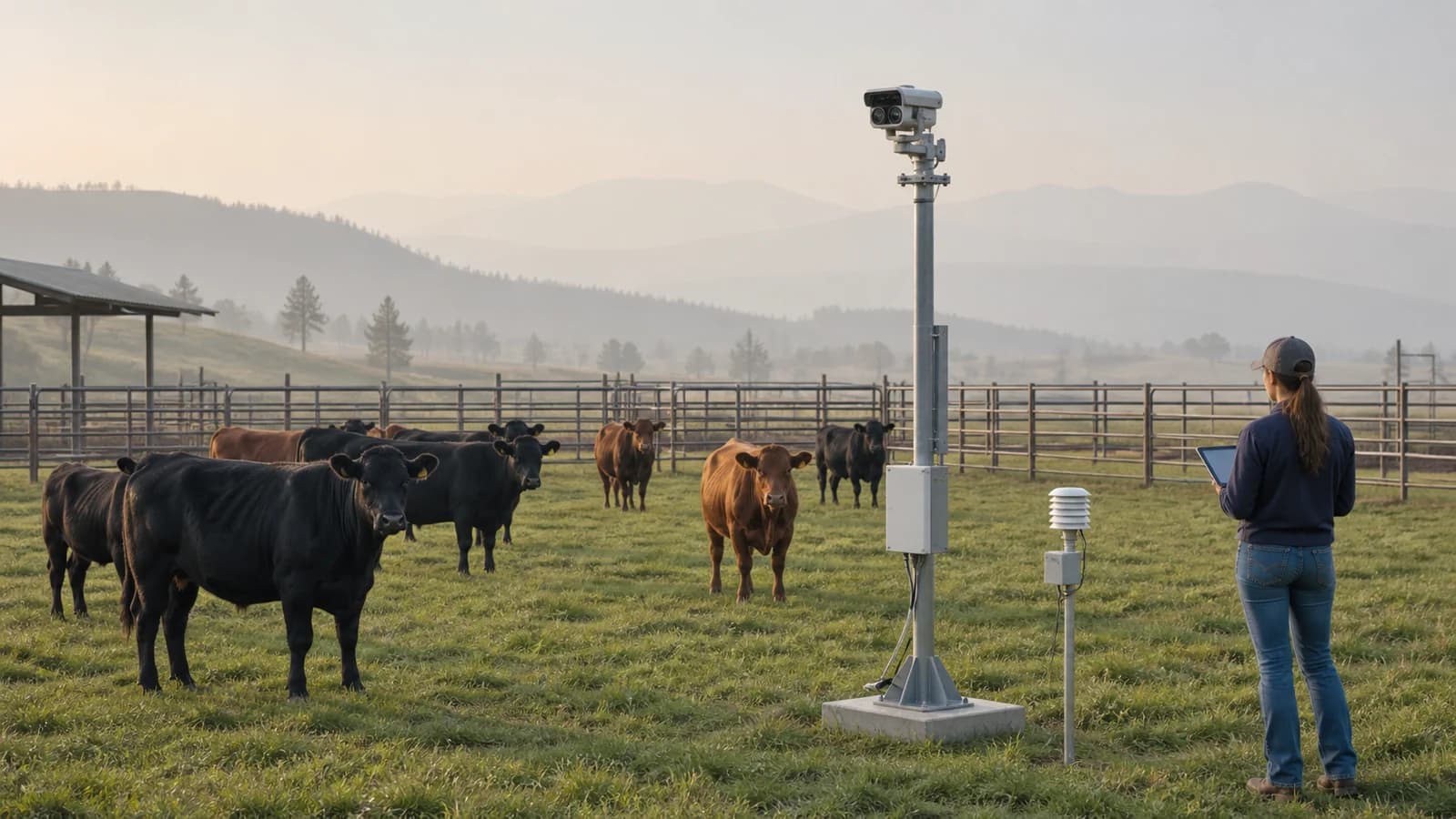
A cattle wildfire-smoke study should align local PM2.5, weather, identity, camera coverage, behavior, samples, production measures, and interventions on one timeline.
Cameras preserve visible behavior and location. They do not measure inhaled dose, diagnose injury, or set a response threshold.
Start with exposure
Measure the air the cattle actually experienced
PM2.5 means airborne particles no wider than 2.5 micrometers. Researchers often use it as one measure of wildfire-smoke exposure.
A regional monitor can describe surrounding air. It may not represent conditions inside a barn, behind a windbreak, or beside a pen.
Place a qualified monitor near the study area when the protocol requires local exposure data. Keep its position, interval, clock, calibration, and outages.
Record weather and smoke-source evidence beside PM2.5. This helps separate wildfire smoke from dust, heat, humidity, ventilation, and routine cattle work.
What recent research shows
Natural smoke events make timing and follow-up part of the design
A 2026 dairy-cattle study followed two natural smoke events. The researchers joined hourly PM2.5, weather, smoke-source checks, samples, and production records.
Their air monitor was 5.7 kilometers from the site. The authors noted that this could miss conditions inside the cattle microenvironment.
The event timing also prevented a standard baseline. Researchers compared smoke periods with a later low-particulate period and reported that limitation.
A separate beef-cattle experiment used four cameras and two air monitors. It recorded behavior continuously and air quality every minute during exposure and follow-up.
The active USDA-funded research program includes cows, calves, controlled work, natural exposure, and mitigation testing. That range shows why one record design cannot answer every question.
Field research protocol
Seven checks for a reviewable wildfire-smoke study
Define the exposure question
Name the cattle group, exposure period, outcome, follow-up window, and comparison before the smoke event begins.
Measure air near the cattle
Record sensor location, height, clock, calibration, sampling interval, units, quality flags, and every outage.
Separate smoke from heat
Keep temperature, humidity, wind, solar load, pen conditions, and smoke-source evidence beside the particulate record.
Join identity and location
Connect each animal or study group to the pen, time, camera view, handling event, and any movement between locations.
Preserve visible behavior
Keep original video, coverage state, zone definitions, observation labels, reviewer decisions, and periods with blocked or missing views.
Freeze samples and outcomes
Record collection time, method, handler, sample ID, instrument, production measure, protocol version, and excluded result.
Follow the recovery period
Continue the same record after air quality improves. Preserve delayed samples, production measures, behavior, interventions, and protocol changes.
Research record
Keep five records connected to every reported result
| Record | What to keep | Why it matters |
|---|---|---|
| Exposure | PM2.5, other selected pollutants, sensor location, interval, calibration, quality flags, and smoke-source evidence | Defines the environmental record without treating a distant reading as an animal dose. |
| Conditions | Temperature, humidity, wind, solar load, housing, ventilation, dust, feed delivery, and handling | Keeps heat, housing, and routine events visible beside smoke exposure. |
| Cattle | Study ID, group, pen, age or stage, movement, camera coverage, and direct observations | Shows which cattle were present and what reviewers could see. |
| Samples | Collection time, sample ID, method, handler, storage, laboratory record, and missingness code | Protects the link between exposure time and qualified measurements. |
| Outcomes | Study-defined behavior, intake, weight, milk, clinical, or physiological measure with its method and version | Prevents a camera observation from being reported as a different measurement. |
How Livestock Technologies helps
Keep camera observations and study records together
Livestock Technologies configures fixed RGB and thermal capture around study cattle, zones, and time windows. On-site processing can retain source files, coverage states, and versioned exports.
Researchers can join visible pen presence, movement, bunk activity, water-zone activity, and behavior labels with qualified air, weather, sample, and production records.
The documented Tuskegee field deployment includes fixed RGB and thermal cameras, solar nodes, wireless links, and on-site processing. It proves the installed capture mechanism, not a smoke-study result.
Explore the research platform and what the cameras record before setting the study clock and export plan.
Review before analysis
Six questions for the final data review
- Is the exposure question written before analysis?
- Does the air record represent the cattle microenvironment?
- Can every animal or group be located on the study clock?
- Are heat, handling, housing, and equipment changes preserved?
- Do camera labels link back to original video and coverage state?
- Does follow-up continue after the visible smoke clears?
Sources and current research
Read the studies behind the protocol
A practical next step
Bring one exposure question and one trusted outcome
We can map camera views, clocks, cattle identity, air and weather inputs, review rules, coverage states, and exports for a focused study.
Plan a cattle air-quality study