Answer first
A thermal image is useful only when its field conditions stay attached
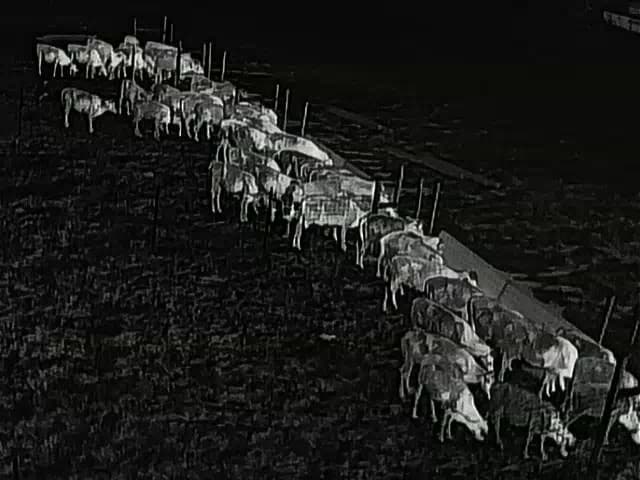
A useful cattle study locks the body region, settings, distance, angle, time, weather, identity, and reference measurement before collection begins.
Thermal images show surface-temperature patterns. They do not, by themselves, prove core temperature, heat stress, illness, or the cause of a change.
Start with the measurement
Define what the camera records and what the study must prove
Infrared thermography turns radiation from a surface into a temperature map. Researchers often shorten that term to IRT.
The map changes with the selected body region and the way the image is captured. Sunlight, wind, moisture, mud, hair, distance, and camera angle can also change the reading.
Begin with a specific outcome. Examples include ocular surface temperature at a set time or the change in dorsal surface temperature after shade access.
Then name the reference. It may be a qualified environmental index, direct physiological measure, or another study-defined instrument. Keep its clock and quality state with the thermal file.
What recent research shows
Standard capture rules are part of the scientific result
A May 2026 systematic review evaluated 23 cattle studies. The authors found that body region, environment, distance, angle, and calibration choices limit comparisons across studies.
A July 2026 cattle field study shows the needed discipline. Researchers fixed flight height, used a perpendicular view, recorded emissivity, and selected frames with clear cattle outlines.
A separate thermal-RGB study reported different cattle-detection results across the two camera types. The authors also documented alignment problems caused by different optics, resolution, and field of view.
These studies answer different questions. Together, they show why a thermal result needs its complete capture and review record.
Field research protocol
Seven checks for reproducible cattle thermal imaging
Name the measurement and reference
State the exact surface-temperature measure, body region, time window, and comparison. Name the qualified reference used to test the thermal result.
Choose one body region
Write the landmark and drawing rule before collection. Do not switch between eye, nose, flank, back, or another region after seeing the data.
Lock the camera record
Keep the camera, lens, resolution, radiometric format, calibration state, emissivity setting, reflected temperature, and software version with every collection period.
Control distance and angle
Use a repeatable camera position or record the distance and angle for each image. Mark motion blur, blocked views, and frames outside the study rule.
Record the field conditions
Capture air temperature, humidity, wind, sunlight, shade, time, surface moisture, mud, dust, and recent animal movement. These conditions can change the surface pattern.
Join identity and clocks
Connect the thermal file, RGB view, animal or group ID, pen, weather record, and direct measurement on one clock. Preserve every manual correction.
Freeze source data and decisions
Keep original radiometric files, checksums, region masks, exclusions, reviewer decisions, code, and model versions. A later reviewer should be able to rebuild the reported result.
Research record
Keep five records connected to every reported value
| Record | What to keep | Why it matters |
|---|---|---|
| Capture | Camera, lens, file format, settings, calibration, distance, angle, time, and checksum | Shows how the thermal image was made. |
| Animal | Study ID, pen, breed, coat, body region, position, movement, and visible surface state | Keeps biological and positioning differences visible. |
| Environment | Air temperature, humidity, wind, solar load, shade, dust, mud, and moisture | Separates field conditions from animal response. |
| Reference | Direct measure, instrument, operator, timing gap, method, and quality state | Defines what the thermal result is tested against. |
| Review | Region mask, exclusion reason, software, code, threshold, reviewer, and version | Makes processing choices reviewable. |
How Livestock Technologies helps
Keep RGB, thermal, identity, and study records on one timeline
Livestock Technologies builds fixed RGB and thermal capture around study-defined cattle, zones, and times. On-site processing can retain paired source files, quality states, and reviewable exports.
RGB views provide visible scene context beside thermal patterns. EID or RFID references, pen records, weather data, and qualified measurements can join the same study clock.
The documented Tuskegee field deployment includes fixed RGB and thermal cameras, solar nodes, wireless links, and on-site processing. It proves the installed capture mechanism, not a thermal-health outcome.
Explore the research platform and the camera and edge system before setting the collection plan.
Review before analysis
Six questions for the final data review
- Is the surface-temperature measure defined before analysis?
- Does every result use the same body-region rule?
- Are camera settings, distance, angle, and calibration preserved?
- Are sunlight, wind, moisture, mud, and dust visible in the record?
- Can each thermal file be joined to identity, time, RGB context, and its reference?
- Are exclusions, corrections, software, and model versions retained?
Sources and current research
Read the studies behind the protocol
A practical next step
Bring one thermal question and one trusted reference
We can map the camera positions, paired RGB views, clocks, identity links, weather record, review rules, and exports for a focused cattle study.
Plan a cattle thermal-imaging study