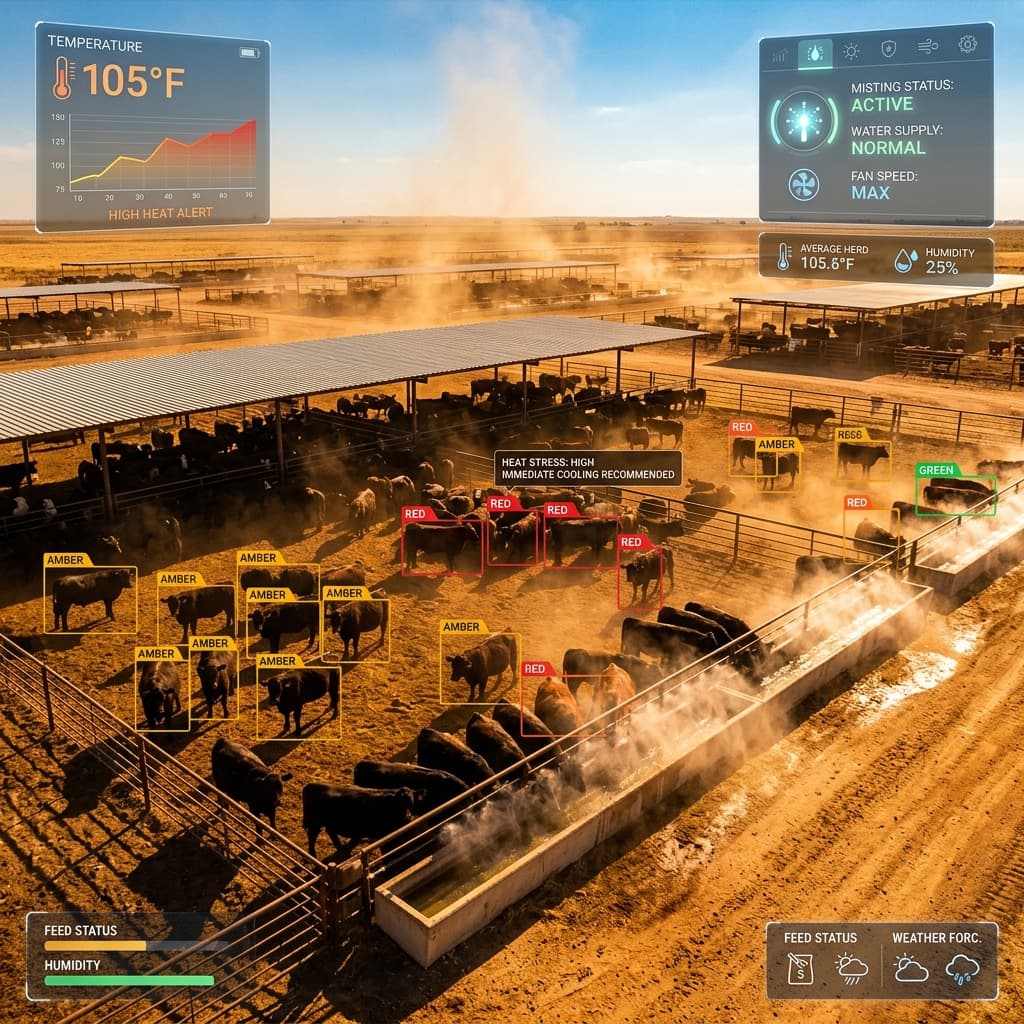
As summer temperatures rise, beef producers and feedlot managers need a documented heat-response plan. Heat stress can affect cattle comfort, behavior, performance, and welfare, but the impact varies with weather, cattle condition, pen design, shade, water access, and management. Camera observations can add reviewable evidence to established weather and animal-care checks.
The Internal Furnace: Thermodynamics of a Ruminant
To understand why cattle are so vulnerable to heat, we must look at their biology. Cattle are ruminants, meaning they rely on microbial fermentation in the rumen to digest fibrous forage. The rumen is essentially a massive, active fermentation vat operating at around 101.5°F to 102.5°F. While this internal fermentation furnace is a biological miracle for extracting energy from grass, it also generates immense metabolic heat.
During a hot summer day, an animal accumulates thermal energy from external conditions and internal metabolism. Cattle use several mechanisms, including increased respiration, to dissipate heat. The Temperature-Humidity Index (THI)combines ambient temperature and relative humidity, but a response threshold should follow the operation's veterinary and extension guidance rather than one universal number.
"When heat accumulation exceeds heat dissipation, the animal enters a state of thermal stress, diverting physiological resources away from growth just to survive."
Why Periodic Checks Benefit From Additional Evidence
Pen riders and animal-care teams remain central to heat-stress response. Because an in-person check is a point-in-time observation, a camera archive can help the same team review changes between rounds—including shade use, water-area congestion, posture, and visible respiration patterns.
Camera observations are decision-support evidence, not a diagnosis. Any alert or unusual pattern still requires human review and should follow the operation's animal-care protocol.
Animal behavior can change when people or equipment enter a pen. Reviewing observations from before, during, and after a check may therefore provide useful context that a single pass cannot capture.
Heat-Event Review Timeline
Use visible patterns, weather context, zone activity, and pen checks to organize the heat-event review:
Cattle alter feed bunk visits, preferring early morning or late night eating, throwing off precise ration management.
Animals pack tightly under shade structures, which counter-intuitively blocks breeze and traps body heat.
Visible flank movement may increase. Camera-derived respiration estimates require site-specific validation against human observations.
Cattle crowd around water troughs, blocking access for more submissive penmates and spiking stress levels.
Adding Camera Evidence to Heat-Stress Monitoring
Fixed cameras can extend the observation window available to animal-care teams. Livestock Technologies organizes relevant clips, weather context, zone activity, and pen observations into a heat-event review workflow. Cameras support but do not replace direct animal assessment and the feedlot heat and animal-health plan.
Camera coverage is affected by crowding, structures, dust, weather, lighting, and animals blocking one another. A deployment should document coverage gaps, observation confidence, downtime, and when manual checks are required. Processing can occur on site, subject to an explicit data-retention and backup plan.
Respiration Review
Candidate flank-motion estimates can be placed beside the source clip so staff can review the evidence. Accuracy must be measured under the operation's actual camera angles and conditions.
Shade Clustering Telemetry
Pen-level occupancy patterns can highlight where cattle are clustering. Staff can compare those observations with weather, shade, wind, and facility conditions.
Water Access Monitoring
Visible congestion near a trough can create a review item. Staff still determine whether the cause is heat, water availability, social behavior, camera perspective, or another condition.
Human-Approved Cooling Workflows
Cooling actions affect cattle, water use, pen conditions, and equipment. Camera evidence can be routed into an existing operating procedure, but activation thresholds, safeguards, and authority should be set and tested by the feedlot team.
A pilot can compare observations with weather data and existing cooling logs before any automated control is considered. Useful workflow questions include:
- Trigger Review: Which combination of weather, animal observations, and staff confirmation should prompt action?
- Zone Context: Can the team distinguish a true pen-level concern from a coverage gap or temporary clustering?
- Safe Controls: What manual override, equipment interlock, audit log, and fallback procedure are required?
Building a Site-Specific Heat-Monitoring Business Case
Financial impact cannot be responsibly estimated from a generic feedlot example. Establish a baseline, define a pilot period, and compare verified operational records before assigning savings or performance gains:
| Metric | Baseline Record | Pilot Evidence |
|---|---|---|
| Water Use (by pen and cooling event) | Metered use and control logs | Same measures during the pilot |
| Animal Response (approved welfare and performance measures) | Historical records with weather context | Predefined comparison reviewed by staff |
| Operations (alerts, reviews, and interventions) | Current labor and response logs | False positives, missed events, and response time |
| Net Financial Impact After total pilot cost | Document the current cost | Calculate only from verified outcomes |
Protect Your Margins This Summer
Connect with the Livestock Technologies team to define camera coverage, human-review rules, validation measures, and integration requirements for a bounded heat-monitoring pilot.