The short answer
Use the official sample as an anchor, then connect every observation without blending the evidence.
A useful H5N1 cattle surveillance record links the approved laboratory sample and result with herd and animal identifiers, qualified clinical records, milk and production context, cattle and equipment movements, fixed-camera observations, environmental conditions, and explicit missing-data states. Each source keeps its own timestamp, definition, owner, and confidence so investigators can study timing and possible links from reviewable evidence.
Why this question is current
Current detections and new transmission research make study timing a live problem
USDA APHIS continues nationwide H5 livestock testing through the National Animal Health Laboratory Network and National Veterinary Services Laboratories. Its National Milk Testing Strategy, interstate-movement testing, voluntary herd-status program, state programs, and producer-requested testing create several legitimate entry points into the surveillance record. The research dataset has to retain which pathway produced each sample.
In July, CIDRAP reported recent dairy-cattle detections in Utah, Idaho, and Texas from APHIS updates. Ohio State also reported a 2026 experimental study showing that infection could be established with a very small intramammary inoculum while several tested transmission routes produced more nuanced results. Together, those developments keep sample timing, route hypotheses, and source-linked data central to current cattle research.
The official detection record, APHIS testing program, independent reporting, and new peer-reviewed transmission work make careful data alignment especially important. Each sample, observation, and result needs its source, time, animal or herd context, and testing pathway preserved.
Start with the question
Infection status, clinical signs, milk change, and visible behavior are different outcomes
A laboratory result answers a different question from a veterinarian's clinical assessment, a production record, or a camera observation. The same animal may have evidence from all four layers, but those records should meet on a timeline rather than become one blended label.
Write the primary outcome and index time before deriving features. Name the herd and cattle population, sample pathway, observation unit, comparison group, follow-up window, qualified status source, and treatment of repeated samples. Then decide which movements, behaviors, milk measures, and environmental variables are exposures, covariates, candidate predictors, or outcomes.
A researchable question
Among cattle linked to an APHIS-aligned positive herd sample, how do predefined feeding-zone presence and visible activity windows differ before and after the collection time compared with matched observation windows from the same facility?
That question identifies the official anchor, unit of analysis, camera variables, baseline, comparison design, coverage rules, and facility context. Laboratory and qualified animal-health methods determine H5N1 status; the camera layer contributes longitudinal observation evidence.
Surveillance protocol
Six decisions to make before retrospective review or prospective enrollment
Define the official status source
Name the approved laboratory, assay, sample type, collection protocol, result identifier, reporting path, and investigator responsible for the qualified status. Keep preliminary, presumptive, confirmed, and negative states distinct.
Build the herd and animal clock
Synchronize sample collection, milk-production records, clinical observations, animal and pen or group identifiers, cattle movements, equipment contact, personnel activity, and relevant facility events to one time standard.
Predefine observation windows
Choose ordinary baseline windows plus periods before and after official collection times. State which animals, groups, zones, behaviors, and environmental measures are eligible for review before outcomes are known.
Preserve each evidence layer
Retain laboratory, veterinary, production, movement, camera, and environment sources separately. Derived variables should point back to the versioned source record and the rule that created them.
Code visibility and missingness
Camera outage, occlusion, uncertain identity, incomplete movement records, delayed sampling, unavailable milk data, and reviewer disagreement each need an explicit state instead of a silent blank.
Lock the analysis handoff
Version the cohort, ethogram, feature definitions, exclusions, adjudication process, comparison design, and export schema. Preserve the original clips and source identifiers for later audit or replication.
Evidence architecture
Give every source a defined role in the study
Official laboratory record
Strongest for: Sample identity, assay, collection time, result, and reportable status
Research role: Defines the qualified infection-status source and index time
Veterinary and production record
Strongest for: Clinical assessment, milk change, care, treatment, and disposition
Research role: Adds qualified health and production context around the sample
Movement and contact record
Strongest for: Cattle transfers, shared equipment, people, vehicles, groups, and locations
Research role: Supports epidemiologic linkage and exposure-window construction
Fixed-camera observation
Strongest for: Visible feeding-zone presence, movement, posture, grouping, and reviewable time-place context
Research role: Adds longitudinal observation windows with explicit coverage states
Environment and facility data
Strongest for: Weather, ventilation, heat load, lighting, routines, and infrastructure events
Research role: Supports competing explanations, stratification, and reproducibility
Where cameras add value
Preserve reviewable behavior and time-place context around official samples
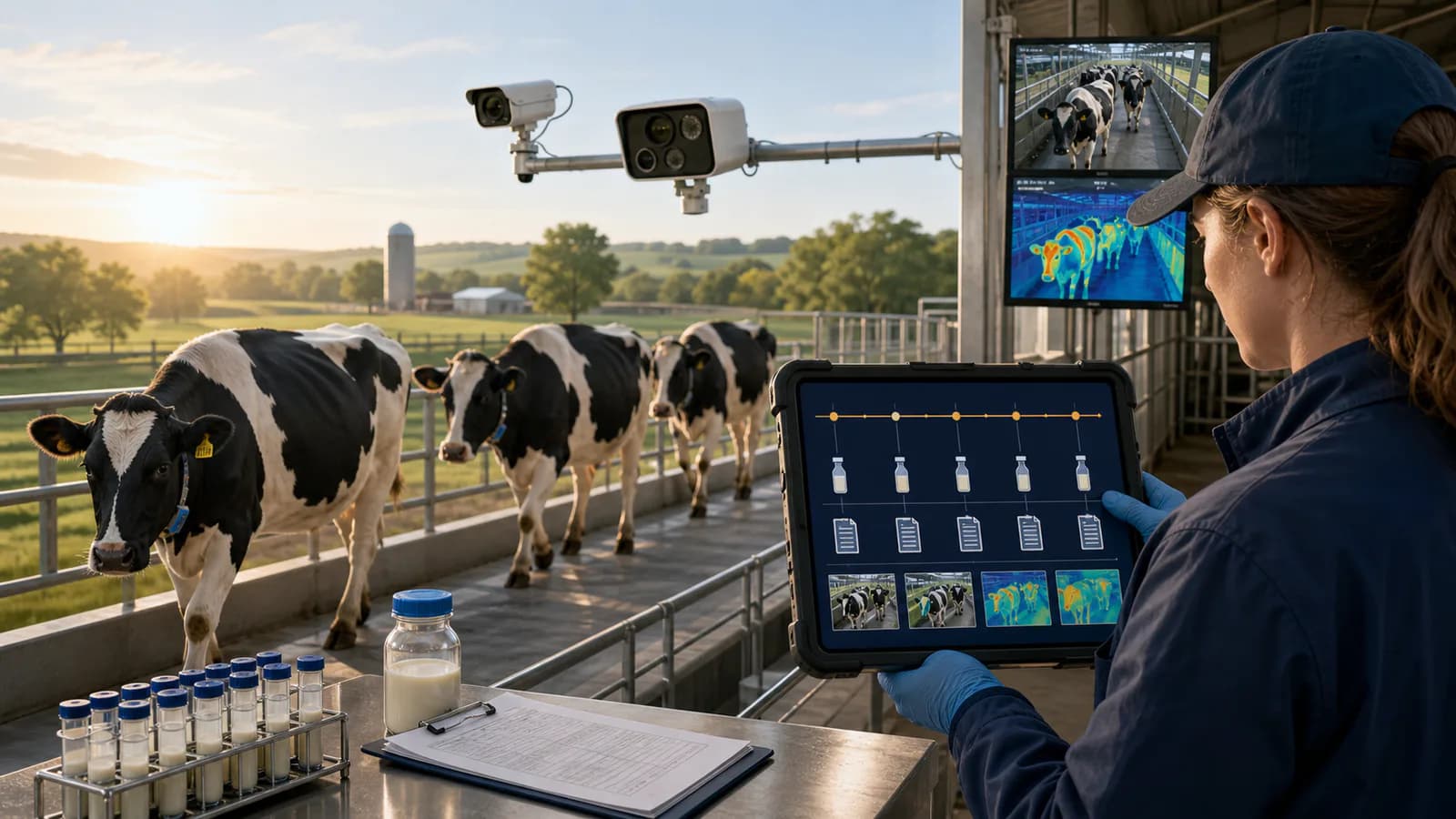
Livestock Technologies builds fixed RGB and thermal research infrastructure that can retain time-bounded evidence of visible movement, posture, grouping, and presence near defined feed, water, lane, or resting zones. Researchers can index those observations to sample windows, animal or group identifiers, facility events, coverage states, and original clips.
The strongest design includes ordinary comparison periods. Sampling only after a positive result creates a selected record; matched baseline windows help investigators compare the same facility, routine, visibility, season, and cattle class. Low-confidence identity, occlusion, and camera outage should move into adjudication and missing-data fields rather than disappear from the dataset.
RGB views preserve visible surface and behavior context. Thermal views can support controlled study of surface-temperature patterns when emissivity, distance, angle, weather, calibration, and body location are documented. The research protocol decides how those observations are used.
See the company's on-site capture and evidence-review platform and the field infrastructure documented at the Tuskegee University research feedlot.
Protocol meeting checklist
Settle ownership, timing, coverage, and publication rules before review begins
- Approved testing pathway, laboratory, assay, sample type, collection protocol, and result identifiers
- Herd, animal, group, location, equipment, vehicle, and personnel identifiers available to investigators
- Primary outcome, index time, observation unit, comparison design, and repeated-sample handling
- Clock synchronization across laboratory, clinical, production, movement, camera, and environment systems
- Camera map, visible behaviors, observation windows, ordinary comparison periods, and occlusion rules
- RGB and thermal capture settings, quality gates, calibration records, and retained source media
- Reviewer training, blinding, disagreement handling, adjudication, and versioned ethogram
- Missing-data categories, access control, retention, export schema, correction log, and publication archive
For research teams
Design the surveillance record before the first review window opens.
Bring the testing pathway, sample plan, available herd and movement records, facility map, observation question, study window, data-governance requirements, and publication plan. We can help define camera coverage, synchronized RGB and thermal capture, source-linked review evidence, missing-data states, and a bounded validation plan for the research infrastructure.
Sources and current guidance
- USDA APHIS: Testing for HPAI H5N1 in Livestock
- USDA APHIS: 2026 HPAI H5N1 Requirements and Recommendations for Livestock
- Ohio State: Experimental H5N1 dose and transmission-route research in dairy cattle
- CIDRAP: July 2026 H5N1 detections in Utah, Idaho, and Texas dairy cattle
Published August 9, 2026. Testing, case status, movement restrictions, biosecurity, clinical care, and occupational-health decisions belong with APHIS, state animal-health officials, approved laboratories, veterinarians, institutional approvals, and the current guidance responsible for each study and herd.