The short answer
Build one timeline without pretending every source measures the same thing.
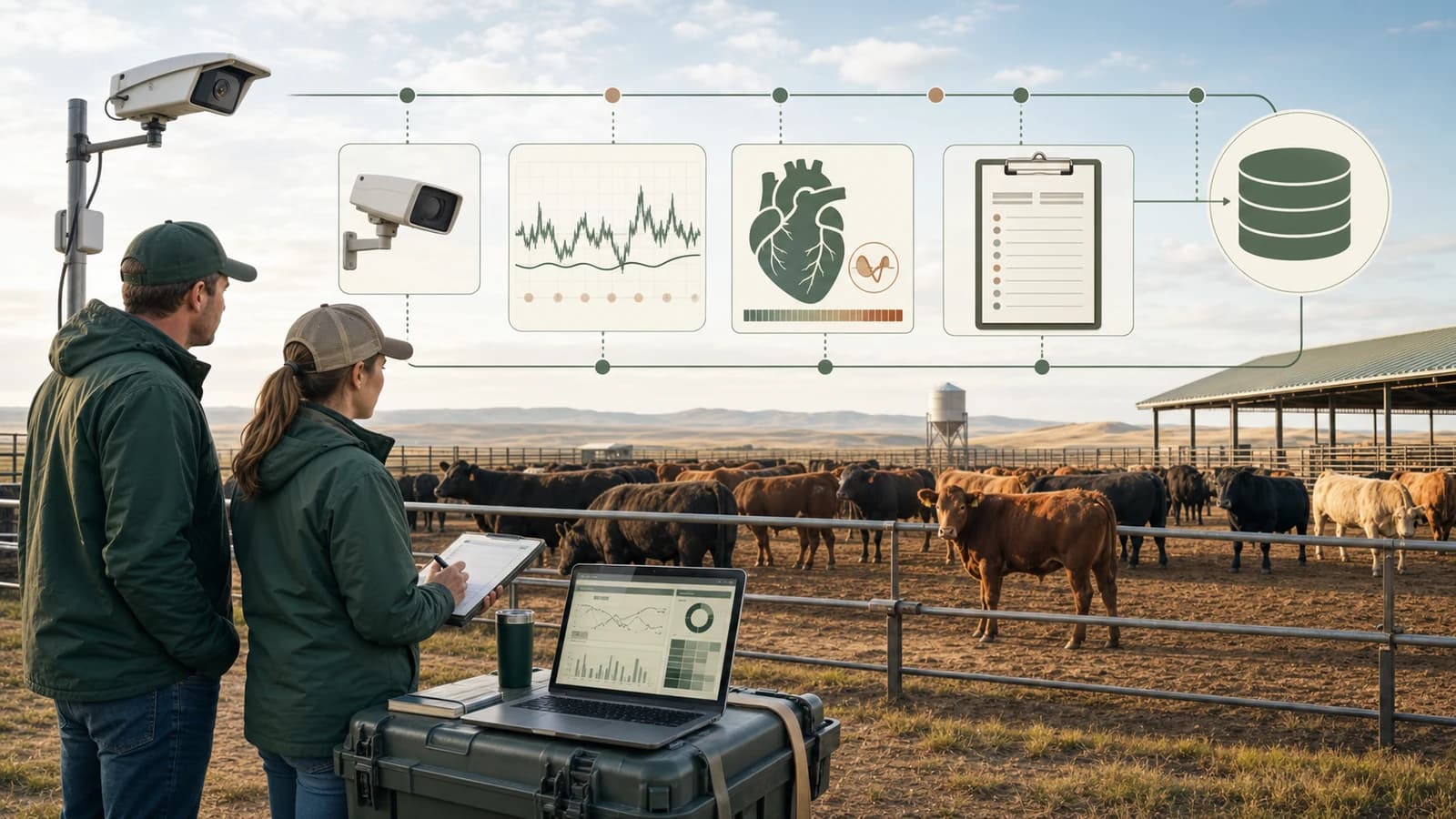
A useful BCHF study links veterinarian-assigned cases, pulmonary arterial pressure, harvest heart scores or postmortem findings, cattle and pen records, camera-observed behavior, and environmental context. Each source keeps its own definition, timestamp, confidence, and missing-data state. That structure lets researchers study onset and competing explanations while keeping clinical judgment with qualified animal-health professionals.
Why this question is current
The new BCHF literature is asking for better phenotypes, timing, and context
A July 2026 issue of Veterinary Clinics of North America: Food Animal Practice brings current work on ruminant cardiology together. Its BCHF phenotyping review describes three primary approaches—pulmonary arterial pressure, heart scoring, and postmortem examination—and explains that their cost, timing, accuracy, and bias differ. The review identifies disease-onset timing and environmental factors as important gaps for predictive-tool development.
USDA Agricultural Research Service continues to describe BCHF as an emerging priority in feedlot cattle in the Western Great Plains, including well-managed operations. Independent Oklahoma Farm Report coverage of Oklahoma State University Extension's Mark Johnson emphasized the same data problem in practical terms: more phenotypes help researchers connect heart scores, genetics, and feedlot outcomes.
The July clinical review and the current USDA research priority point to the same practical need: researchers need a time-aligned record that connects animal history, environment, clinical work, and endpoint measurements without treating them as interchangeable evidence.
Define the outcome first
Risk, onset, clinical presentation, and endpoint heart score are different outcomes
A genetic-risk marker, a pulmonary arterial pressure measurement, a veterinarian's case assessment, and a harvest heart score belong in the same research program, but they are not interchangeable labels. Each occurs at a different point in the animal's timeline and carries a different selection process.
Write the primary outcome before building a feature set. Name the cattle population, experimental unit, follow-up period, qualified case definition, comparison group, competing events, and endpoint. Then decide which observations are explanatory context, candidate predictors, or outcomes.
A researchable question
“Among cattle with a veterinarian-assigned BCHF case, which changes in visible activity and zone presence occur during the 14 days before the first qualified clinical record, compared with matched cattle in the same feeding phase?”
That question identifies the index time, observation windows, comparison set, behavior definitions, visibility rules, and covariates the study needs. “Can a camera detect heart failure?” skips those decisions and asks an observation stream to make a clinical conclusion.
Phenotyping protocol
Six decisions to make before retrospective review or prospective enrollment
Write the case definition first
Specify who assigns a BCHF case, which clinical and exclusion criteria apply, which records are required, and how uncertain cases remain labeled. Preserve the veterinarian's source record rather than replacing it with a derived category.
Anchor the phenotype to time
Align receiving, processing, treatment, pen moves, body weight, feed phase, pulmonary arterial pressure, clinical observations, removals, harvest heart scores, and postmortem findings to one study clock.
Define observation windows
Choose fixed windows before and after the first qualified clinical record, plus matched control windows. Sample ordinary periods too, so behavior near a case event can be compared with the animal, pen, and feeding phase baseline.
Keep context beside behavior
Carry temperature, humidity, dust, elevation, ration and feed-delivery timing, water access, handling events, pen changes, cohort, and camera coverage with the observation instead of trying to reconstruct context later.
Preserve missing and conflicting evidence
Occlusion, uncertain identity, camera outage, absent clinical records, animals removed before harvest, and disagreement between reviewers each need an explicit state. Missingness can shape the apparent phenotype.
Predefine the analysis handoff
Version the ethogram, features, adjudication rules, exclusions, and export schema. Keep original clips and source records addressable so a later model or paper can be traced back to what reviewers actually saw.
Evidence architecture
Give each evidence source a defined research role
Veterinary case record
Strongest for: Clinical assessment, differential workup, treatment, disposition, and case status
Research role: Controls the qualified health interpretation and its timing
PAP, heart score, postmortem
Strongest for: Cardiovascular measurements and endpoint phenotypes
Research role: Supplies defined measures with distinct cost, timing, and selection biases
Fixed-camera observation
Strongest for: Visible posture, movement, grouping, zone presence, and change from a defined baseline
Research role: Adds reviewable behavior and time-place context around study windows
Yard and environment data
Strongest for: Cohort, feed phase, pen, movement, weather, ration, water, and handling context
Research role: Supports stratification, covariate control, and competing explanations
Where cameras add value
Preserve reviewable behavior around the phenotype timeline
Livestock Technologies builds fixed-camera research infrastructure that can retain time-bounded evidence of visible posture, movement, grouping, and presence near defined pen zones. In a BCHF study, those observations become most useful when they are indexed to the animal or candidate set, pen, feeding phase, qualified case time, matched-control window, coverage state, and original clip.
Researchers can predefine daily or event-centered review windows, version an ethogram, retain the source video, and send low-confidence identity or occlusion to human adjudication. The same sampling plan should include ordinary periods so a change is compared with baseline rather than selected only because a case was already known.
Camera observations contribute longitudinal behavior and context; veterinary evaluation and the study's qualified phenotype methods determine BCHF case status. Keeping that boundary explicit makes the observation layer more useful for research, not less.
See how Livestock Technologies structures on-site capture, processing, and evidence review and what the infrastructure looks like in the Tuskegee University deployment report.
Study readiness
What to settle in the protocol meeting
- Primary outcome, experimental unit, cattle population, follow-up period, and comparison design
- Veterinarian-owned case definition, source records, differential process, and uncertain-case state
- PAP, heart-score, postmortem, genetic, production, and removal records available to the study
- Clock synchronization, cattle and pen identifiers, event indexing, and source-record retention
- Camera map, target behaviors, observation windows, matched ordinary periods, and occlusion rules
- Weather, elevation, feed phase, ration, water, handling, pen movement, and cohort covariates
- Reviewer training, blinding, disagreement handling, inter-observer agreement, and version control
- Missing-data categories, competing events, bias analysis, export schema, and publication archive
For research teams
Design the phenotype timeline before the first review window opens.
Bring us the case definition, available clinical and endpoint records, cattle and pen identifiers, site map, behavior questions, study window, and publication requirements. We will help define camera coverage, time alignment, review evidence, missing-data states, and a bounded validation plan for the research infrastructure.
Sources and current research
- Veterinary Clinics: Phenotyping Bovine Congestive Heart Failure
- Veterinary Clinics: Management of Congestive Heart Failure in Beef Cattle Populations
- USDA ARS: Bovine Congestive Heart Failure in Feedlot Cattle
- Oklahoma Farm Report: BCHF and its growing impact on feedlots
- Frontiers in Genetics: Genetic evaluation of BCHF in commercial feeder cattle
Published August 2, 2026. BCHF case definitions, testing options, management decisions, and animal-care protocols belong with the veterinarians, investigators, institutional approvals, and current guidance responsible for each study and operation.