The short answer
Treat the collar as one data source, not the ground truth.
Pair time-stamped collar and GPS events with fixed-camera observations, weather and site context, a predefined cattle-behavior ethogram, and a human review path for disagreement. That design lets a study test containment, learning, behavior, and welfare without asking one sensor to prove itself.
Why this question is current
Virtual fencing is moving from “does it work?” to “what exactly should we measure?”
A 2026 peer-reviewed study in animal compared heifer behavior near virtual and physical electric boundaries. Its central result was not a simple product verdict: boundary proximity mattered more than fence type for several spatial behaviors. That finding is a reminder that location, available area, and paddock context can shape the same outcomes attributed to a device.
Oregon State University researchers are separately evaluating learning, behavioral response, physiology, welfare, and grazing applications. University of Idaho work is testing virtual fencing in public-land settings where cattle, recreation, wildfire recovery, invasive plants, connectivity, and management decisions meet. Current independent industry coverage shows the same technology is attracting active field trials beyond a single university or vendor.
The next useful paper is therefore not another pile of collar events. It is a study that makes cause, context, missing evidence, and animal-level variation easier to see.
Define the outcome first
Containment, learning, behavior, and welfare are different research questions
A boundary-crossing rate can describe containment. It does not, by itself, establish how quickly cattle learned, how responses changed over time, whether social grouping shifted, or what the experience means for welfare. Those outcomes need different sampling windows and evidence.
Write the primary question first. Name the experimental unit, the exposure period, the comparison, and the outcome before the first collar is fitted. Decide whether the study concerns the individual animal, the group, a boundary segment, a paddock, or a grazing period. Then specify how repeated measures and group influence will be handled.
A researchable question
“During the first seven exposure days, how does time spent grazing within 20 meters of the active boundary differ from a matched physical-fence period, after accounting for weather, time of day, forage access, and animal?”
That question tells the team which timestamps, zones, behaviors, covariates, and comparison periods must be captured. “Did virtual fencing work?” does not.
Ground-truth protocol
Six decisions to make before the cattle enter the treatment paddock
Define the behavior before collecting it
Write observable definitions for approach, withdrawal, grazing, standing, walking, lying, regrouping, and boundary crossing. Do not let the sensor vendor define the outcome after the trial.
Synchronize every clock
Collar events, GPS fixes, camera frames, weather data, treatment changes, and observer notes need one time standard. A thirty-second drift can turn the wrong animal or response into the apparent match.
Map camera coverage and blind spots
Record which boundary segments, water points, shade areas, gates, and social gathering places are visible. Treat every uncovered interval as missing evidence, not normal behavior.
Sample quiet periods too
A useful dataset includes ordinary grazing, resting, and movement away from a boundary—not only audio cues, pulses, or crossings. That baseline is what makes a response interpretable.
Preserve disagreement for review
If collar data says one thing and video suggests another, keep both records and the original clip. Disagreement is a research finding to resolve, not a row to silently discard.
Report missingness by condition
Separate collar outage, camera occlusion, identity uncertainty, weather obstruction, and observer uncertainty. One pooled “missing” category hides the conditions that limit generalization.
Evidence architecture
Give every data source one job—and one stated limitation
Virtual-fence collar
Strongest for: Cue, stimulus, GPS position, device status
Cannot answer alone: The full posture, social context, or off-camera reason for a response
Fixed cameras
Strongest for: Visible movement, posture, grouping, boundary approach, and context
Cannot answer alone: A collar command that was not logged into the video timeline or activity outside coverage
Weather and site data
Strongest for: Heat, rain, wind, shade, water, forage, and paddock conditions
Cannot answer alone: Which animal changed behavior or whether the fence event caused the change
Human review
Strongest for: Ambiguous cases, identity checks, and protocol adjudication
Cannot answer alone: Continuous coverage without a reproducible sampling and labeling plan
Where cameras add value
Keep the original behavior around each machine event
Livestock Technologies uses fixed cameras as a continuous observation layer. For a virtual-fencing study, the useful unit is not “more video.” It is a time-bounded clip around a collar event, linked to the treatment period, animal or candidate animals, boundary segment, and study protocol.
The same cameras should preserve non-event periods selected under the sampling plan. Researchers can then compare approach speed, withdrawal, grazing, standing, walking, lying, and group response under the same ethogram. Ambiguous identity or occlusion stays visible in the record instead of being converted into false certainty.
Our system does not sell or control a virtual fence, and this article does not validate a specific collar. Livestock Technologies adds an independent observation layer: continuous local camera evidence, synchronized study data, and reviewable clips that complement the collar vendor's records.
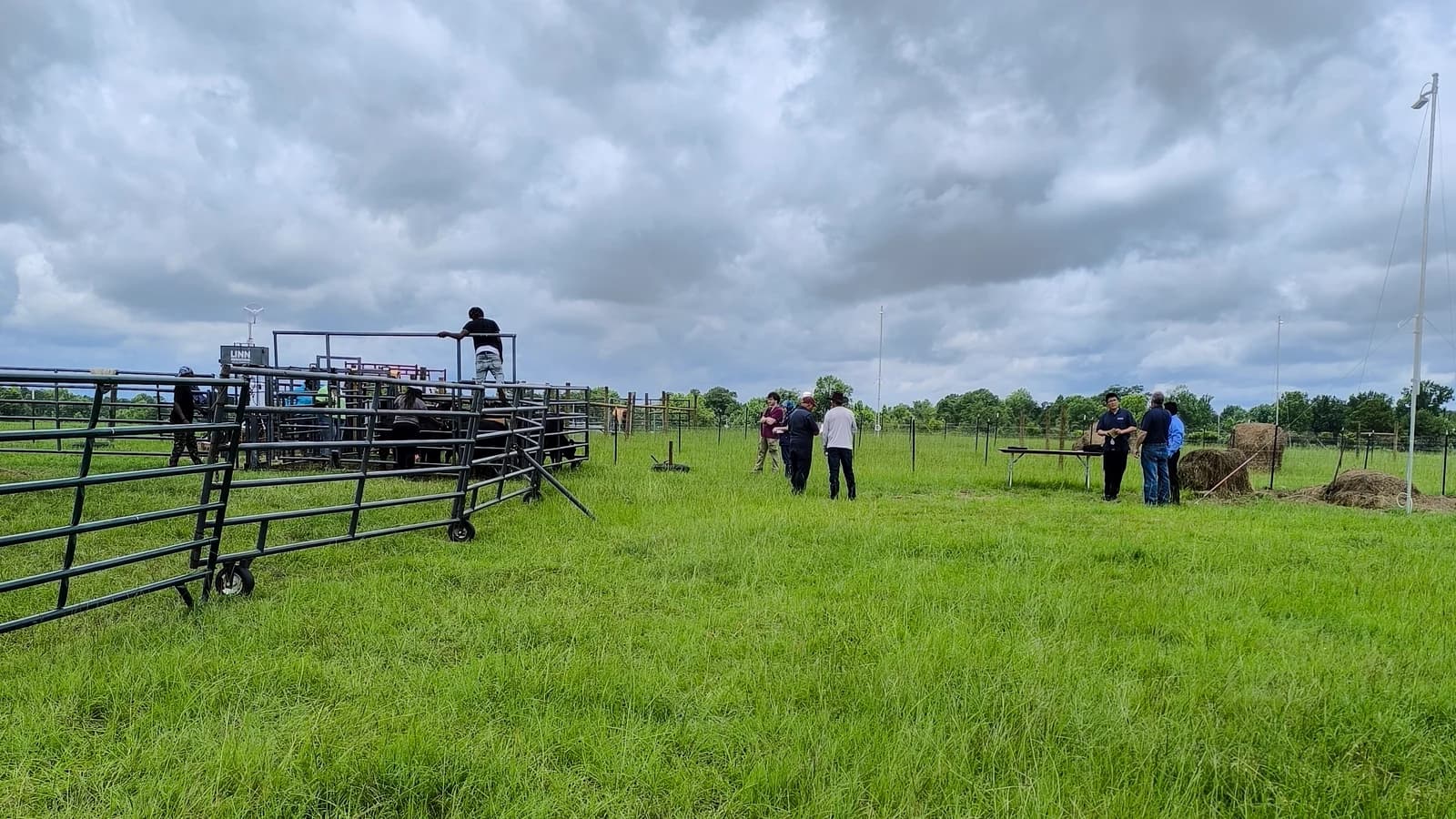
See how we structure fixed-camera livestock observations and what a field installation looks like in the Tuskegee University deployment report.
Study readiness
What to settle in the protocol meeting
- Primary outcome, experimental unit, treatment period, and comparison period
- Cattle-level identity method and the rule for uncertain identity
- Clock synchronization and event-retention format for every data source
- Camera map, boundary zones, expected occlusions, and non-covered areas
- Ethogram, observer training, adjudication, and inter-observer agreement plan
- Sampling of ordinary periods as well as cue, stimulus, and crossing events
- Weather, forage, water, shade, group movement, and human-intervention covariates
- Missing-data categories, exclusion rules, retention period, and publication export
For research teams
Design the observation layer before the treatment starts.
Bring us the research question, paddock or pen map, expected data sources, study window, and publication requirements. We will help define camera coverage, synchronization, identity checks, review clips, and a bounded acceptance plan for the monitoring infrastructure.
Sources and current research
- animal: Comparing cattle behavior near virtual and physical fences
- Journal of Animal Science: Virtual fencing, grazing management, and cattle welfare
- University of Göttingen release: Drawing the line between virtual and physical fences
- University of Idaho: Virtual fencing research on public-land grazing conflicts
- RealAgriculture: Current virtual-fencing research in Western Canada
Published July 30, 2026. Virtual-fencing hardware, training protocols, and research settings vary. Study teams should use the current manufacturer instructions, institutional animal-care approvals, and site-specific welfare and safety procedures applicable to their work.