Answer first
Build one record across every camera
A multi-camera cattle study needs one clock, a map for every view, a stable identity record, and written rules for gaps and handoffs.
Preserve the original video, calibration files, reference labels, model version, and reviewer decisions. Test the finished method on records kept out of development.
Livestock Technologies can provide synchronized RGB and thermal capture, field infrastructure, and research-ready exports for this work.
Why several views change the study
A second camera adds coverage and a new matching problem
One camera may lose an animal behind another animal, a post, a bunk, or the edge of the frame.
An overlapping view can preserve the event. Researchers must still decide whether two observations represent the same animal.
Recent cattle-tracking studies use camera calibration, ground-plane positions, appearance cues, and explicit cross-camera matching. Their reported results belong to their own animals, sites, and methods.
A new study should test the complete field workflow under its own lighting, density, camera placement, and missing-view conditions.
Five steps before collection
Write the handoff and validation rules before the first trial
Set one study clock
Synchronize every camera, sensor, chute record, annotation tool, and intervention log. Record drift checks and corrections.
Map every field of view
Name each camera and mark its visible area, overlap zones, blind spots, height, angle, and expected obstruction.
Define the identity reference
State how visible tags, EID or RFID, chute images, and reviewer decisions connect one animal across views.
Write the handoff rule
Define when a track leaves one view, enters another, becomes uncertain, or remains missing. Keep every unresolved handoff.
Freeze the study split
Separate training, tuning, and test records before final evaluation. Hold out complete animals, dates, views, or sites when the question requires it.
The connected study record
Keep source evidence beside every derived output
| Record | Keep together |
|---|---|
| Source video | Original file, camera ID, start time, duration, frame rate, and checksum |
| Camera map | Location, view boundary, overlap, blind spot, calibration file, and effective dates |
| Animal identity | Study ID, tag references, enrollment dates, pen, and reviewer-confirmed changes |
| Coverage state | Visible, partly blocked, outside view, camera unavailable, or unknown |
| Track output | Model version, track ID, time, view, position, confidence, and handoff state |
| Reference labels | Label guide, annotator, review date, disagreements, corrections, and final status |
Identity and missing views
Do not turn an uncertain handoff into a certain identity
Give every observation an identity state: confirmed, likely, conflicting, or unknown. Keep the source frames and reviewer note behind each correction.
Use a separate coverage state when the animal is blocked, outside the mapped view, or recorded by an unavailable camera.
This distinction prevents a missing view from becoming an assumed behavior. It also lets researchers measure where the capture system failed.
Controlled chute references can connect face, muzzle, visible-tag, and EID or RFID records. They support identity review but do not make every field match certain.
Independent validation
Test the question the study is meant to answer
Choose the validation split from the claim. Hold out complete animals when the goal is tracking unfamiliar cattle.
Hold out later dates for performance over time. Hold out complete cameras or sites when the method must work beyond a familiar view.
Report identity switches, missed tracks, false tracks, coverage time, and unresolved handoffs. Show results by pen, camera, lighting, density, and obstruction when those conditions matter.
Keep test records closed until the method and thresholds are fixed. A reviewer who did not build the model should confirm the final reference labels.
How Livestock Technologies helps
Build a reviewable capture system around the study question
Livestock Technologies deploys fixed RGB and thermal cameras, solar field nodes, wireless links, and on-site processing and storage.
The research workflow can preserve synchronized source media, camera state, coverage notes, versioned outputs, and exports for independent analysis.
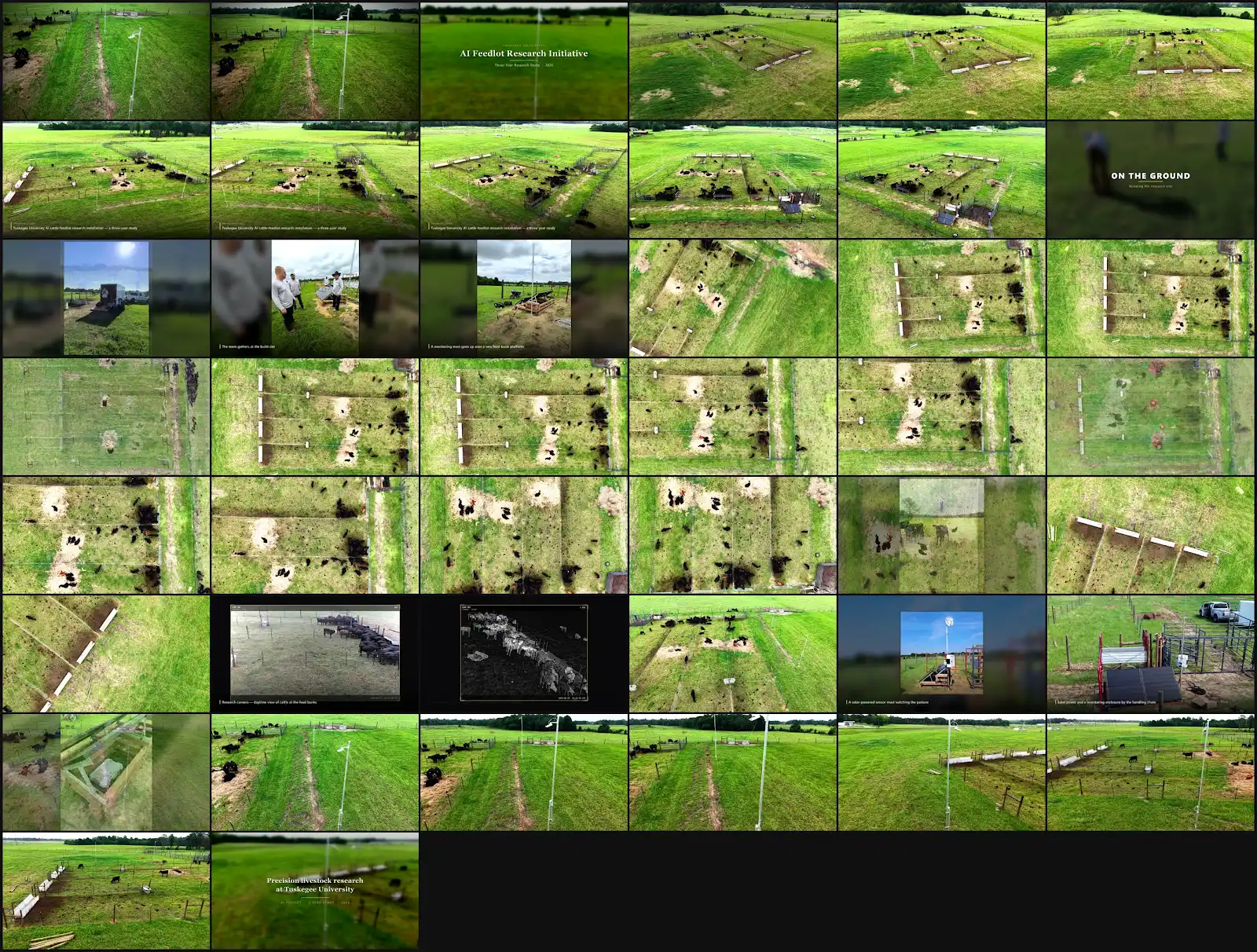
Our June 2026 Tuskegee University deployment documents this field mechanism across four pens and 60 cattle. It does not establish a universal tracking result.
Review the Tuskegee field evidence, the research platform, and what the cameras can record.
Next step
Map the study question before choosing camera positions
Bring the animal group, study timeline, identity source, target observations, and planned validation split. We will map the capture record around them.
Plan a research capture