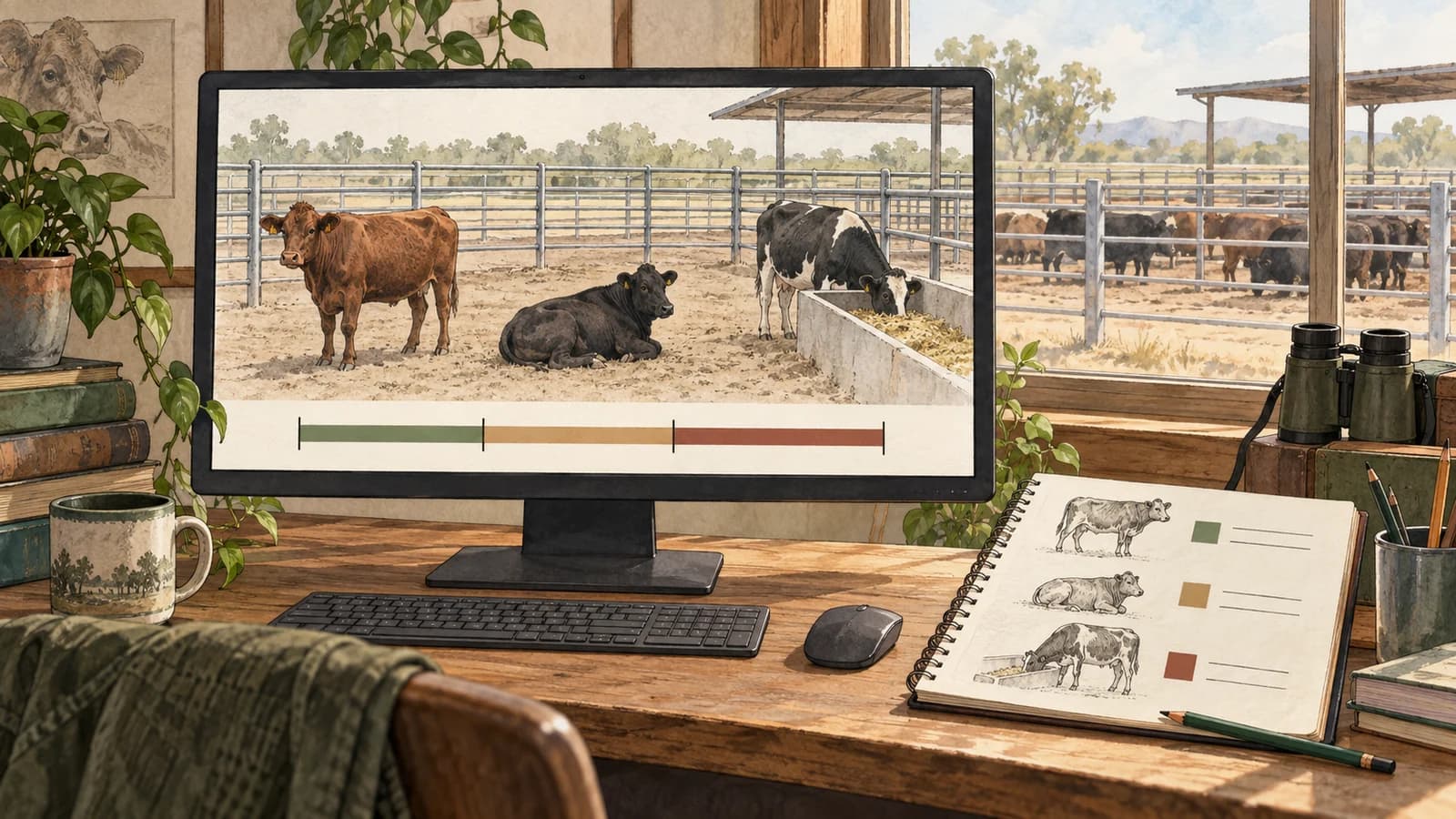
Define the behavior before counting it
A camera gives a study something valuable: footage the team can revisit. Turning that footage into research data takes a second step. Everyone needs to mean the same thing when they apply a label.
Start with the question the study needs to answer. A lying-time study needs clear posture rules. A bunk-use study needs a defined area and a rule for entering or leaving it. Neither automatically requires a long list of every behavior visible in the pen.
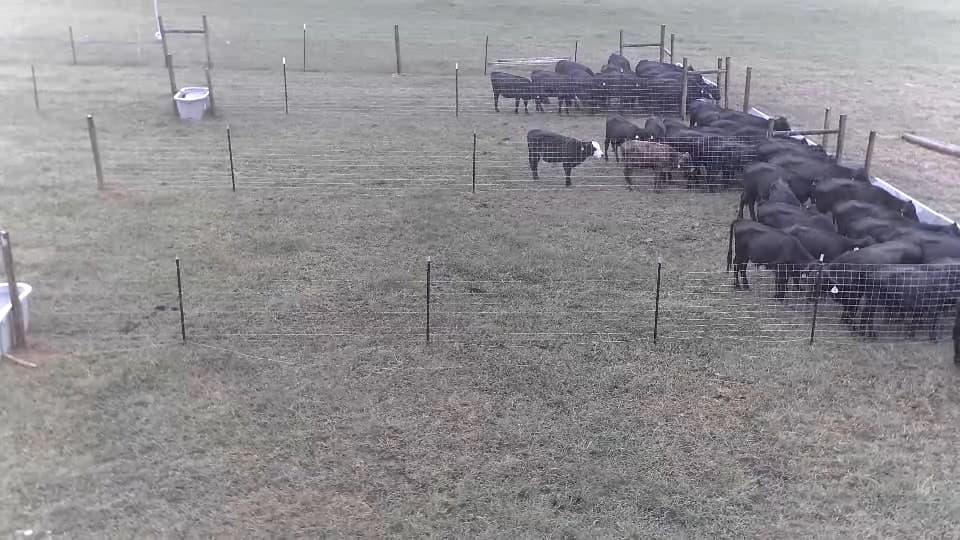
That distinction matters. “In the bunk area” describes a location. “Eating” describes an activity that needs its own visible evidence and definition. Choose the label the camera view can support, then explain what it does—and does not—measure.
Separate a lasting state from a single event
An ethogram is simply the study’s behavior dictionary. BORIS, an open-source observation tool, distinguishes state events with a start and stop from point events recorded at a moment in time. Its behavior descriptions give observers a shared reference.
For your study, write each definition beside a positive example and a difficult example. The examples below are starting points to adapt and test, not a validated cattle ethogram.
- Lying: define the visible posture that starts the state and the posture that ends it. Decide how to handle the transition to standing.
- Zone occupancy: define which part of the animal must cross the boundary. Keep the same rule when the animal enters and leaves.
- A discrete event: identify the visible instant you will mark, such as crossing a defined line. Specify how repeated crossings are counted.
Keep labels separate when they answer different questions. Posture and location may be recorded together; two mutually exclusive posture labels should not overlap for the same animal.
Hidden is not the same as inactive
When another animal blocks the view, do not fill the gap with a guess. Record an out-of-view or uncertain interval according to the study protocol. Distinguish an unseen behavior from a behavior that was observed not to occur.
A simple example changes the result
Imagine a 20-minute clip. An animal is visible for 10 minutes and lies down for 5 of those minutes. That is 50% of its visible time, but 25% of the full clip. The other 10 minutes are unknown—not evidence that it stood.
BORIS’s analysis guidance includes options for handling out-of-sight time in a time budget. Whatever tool you use, state the denominator: total recording time, observable time, or another defined interval. Report missing visibility alongside the result.
Identity needs a rule too. If the reviewer cannot confidently connect an animal across an obstruction, preserve that uncertainty rather than silently joining two tracks. Our research data export guide explains why timestamps, identifiers, and source clips need to stay connected.
Test the labels with two observers first
Have two reviewers independently label the same pilot clips. Include crowded views, transitions, partial animals, and the lighting conditions the study will use—not only the easiest footage.
Compare disagreements before expanding the work. Was the animal hidden? Did the definition leave room for two interpretations? Did reviewers choose different start times? Revise the rule or the view, then try another pilot.
BORIS supports observer-comparison analysis with a chosen time window. Select a comparison method that fits the study and record its settings. A single agreement score cannot replace a clear account of which behaviors and conditions were difficult.
Save the version of the definitions used for each batch. If a rule changes later, decide whether earlier clips need review so the final dataset does not quietly mix two meanings.
Let AI speed the work without hiding the evidence
Computer vision can help find animals and propose labels, but a proposed label and a reviewed research label are not the same thing. Keep the source footage available so the team can inspect errors and ambiguous cases.
The CVB cattle-video dataset paper describes an annotation process that used detection and tracking tools followed by expert correction and behavior labeling. It illustrates how automation and human review can work together. It is an independent grazing-cattle dataset, not a validation result for Livestock Technologies or a feedlot study.
When evaluating a model, keep the testing footage separate from the footage used to train it. Our cattle behavior model-validation guide covers that next step.
Build the capture system around the study
Livestock Technologies provides the field infrastructure that makes repeatable camera research practical: RGB and thermal capture, field connectivity, on-site computing and storage, and review workflows. The Tuskegee deployment report shows that infrastructure in a working research feedlot.
For a new project, start with the behavior, the animals, and the view needed to observe them. Then agree on clip access, time references, identity handling, and the output format with the research team. A tool such as BORIS can inform annotation methods; this article does not claim a built-in BORIS integration.
Our research platform and camera-to-decision workflow connect field capture with evidence people can review. Good stewardship includes making the limits of an observation as clear as the observation itself.
Never lose an animal.
Bring us the behavior you need to study.
Tell us what you want to measure, which animals are involved, and where the study will run. We can discuss camera coverage and research data requirements with your team.
Explore a research partnership →