What the new Georgia research contributes
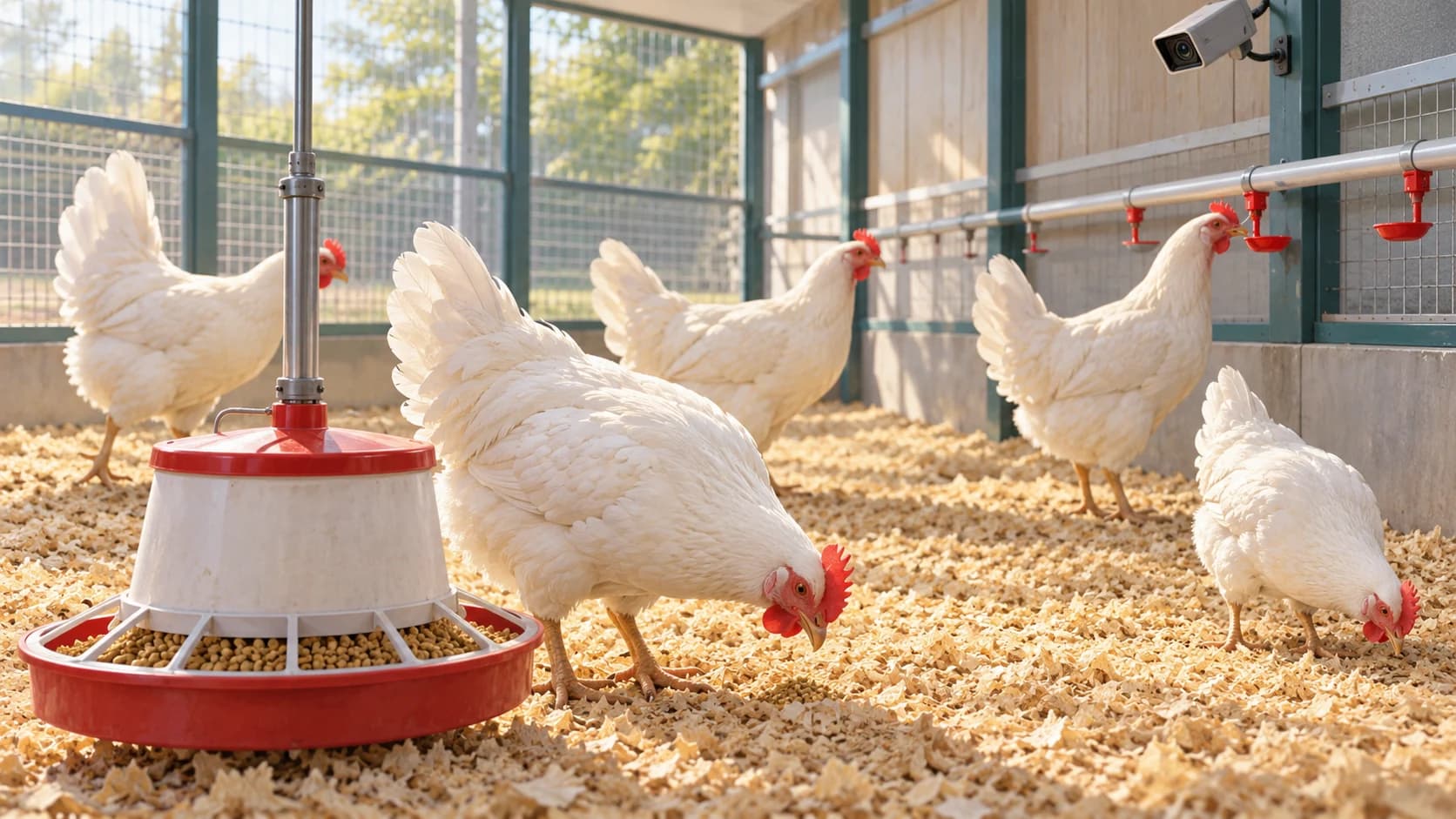
Researchers in UGA's Department of Poultry Science and Poultry Diagnostic and Research Center studied infectious laryngotracheitis, or ILT, under controlled chamber conditions. Their computer-vision work distinguished visible activities and signs in laying hens.
The October 21 university report describes stronger recognition of feeding and drinking than of several other signs, including eye rubbing and head movements. It also calls for larger, more varied datasets and testing in commercial housing.
That difference between behaviors matters. A system may recognize a clear feeder visit more reliably than a brief, partly hidden head movement. One overall score can conceal which observations are useful enough to build on.
The study concerns ILT in controlled laying-hen conditions. It does not establish a visual test for avian influenza or dependable results across other diseases, species and commercial barns.
A behavior detection becomes a warning only after another decision
Think of the research as three connected questions. Observation: did the camera correctly recognize a visible activity? Warning: did a defined change merit someone's attention? Confirmation: what did the veterinary or diagnostic reference establish?
These questions need different evidence. A correctly recognized drinking event is useful information about an image or video interval. It does not, by itself, say how much a hen drank, whether the flock is ill, or which pathogen is present.
A warning rule adds time and context. For example, a research team might ask whether activity in a defined feeder area has changed from comparable observation periods. The team must choose and test that rule; the camera model's behavior labels do not supply it automatically.
Compare the useful review event, not just the image score
Suppose a hypothetical trial produces many correctly labeled feeding images, yet its warning rule repeatedly calls for review after a scheduled change in feeder access. The image recognizer may be doing its job while the warning workflow still needs work.
Conversely, a quiet alert queue might look convenient while missing meaningful changes. Researchers need to examine both the warnings that deserved attention and the relevant events that generated no warning.
Google's explanation of classification metrics distinguishes precision from recall: precision asks how many positive predictions were correct; recall asks how many actual positive examples were found. Neither number answers a useful question until the positive event is defined. A feeding detection and a veterinary-confirmed disease event are different targets.
For a poultry warning trial, a useful result would describe the event definition, unnecessary reviews, missed events and time between the first warning and the chosen reference event. A claimed early warning also needs a stated comparison: earlier than which observation, collection time or result?
Let another flock challenge the idea
An illustrative university project could develop the observation and warning rules in one flock, then test the fixed approach in another. Before that test, the investigators would agree which veterinary reference determines the outcome and which observation periods can be compared fairly.
Keep the distinction visible in the analysis. Did performance change because birds were harder to see, because the behavior recognizer made mistakes, or because the warning rule did not separate the events of interest? Those explanations lead to different improvements.
This gives the next study a practical payoff: researchers can identify whether they need a better view, better behavior labels or a better warning decision. Buying a more powerful model is only one possible response.
Keep the animal-health response connected
A research alert should have a named reviewer and an agreed route to the facility's veterinary team. The USDA APHIS avian-influenza guidance explains that signs vary and directs owners who suspect animal disease to contact their veterinarian for evaluation. Camera review must support that response rather than delay it while waiting for a model score.
For a college research barn, this is a collaboration between poultry science, veterinary expertise and engineering. The valuable outcome is a clearer decision for the care team, supported by evidence they can inspect.
Build the observation infrastructure around the poultry question
Livestock Technologies brings together fixed RGB and thermal views, field connectivity, on-site computing and stored source footage for university research. Our documented Tuskegee installation shows that infrastructure in a cattle research setting; a poultry project needs its own agreed views, software task and species-specific evaluation.
The starting conversation is concrete: which visible activity matters, where can it be seen, what event should prompt review, and how will the team determine the outcome? Those answers connect the camera and data design to the investigator's actual study.
Explore our technology and research capabilities brief to see the documented platform and prepare a project scope.
Never lose an animal.
Bring us the poultry research question.
Tell us the species, housing, observation you need and reference your study will use. We can discuss a camera and data-infrastructure scope with your university team.
Discuss a university research project →