Answer first
Test the forage before the feeding decision
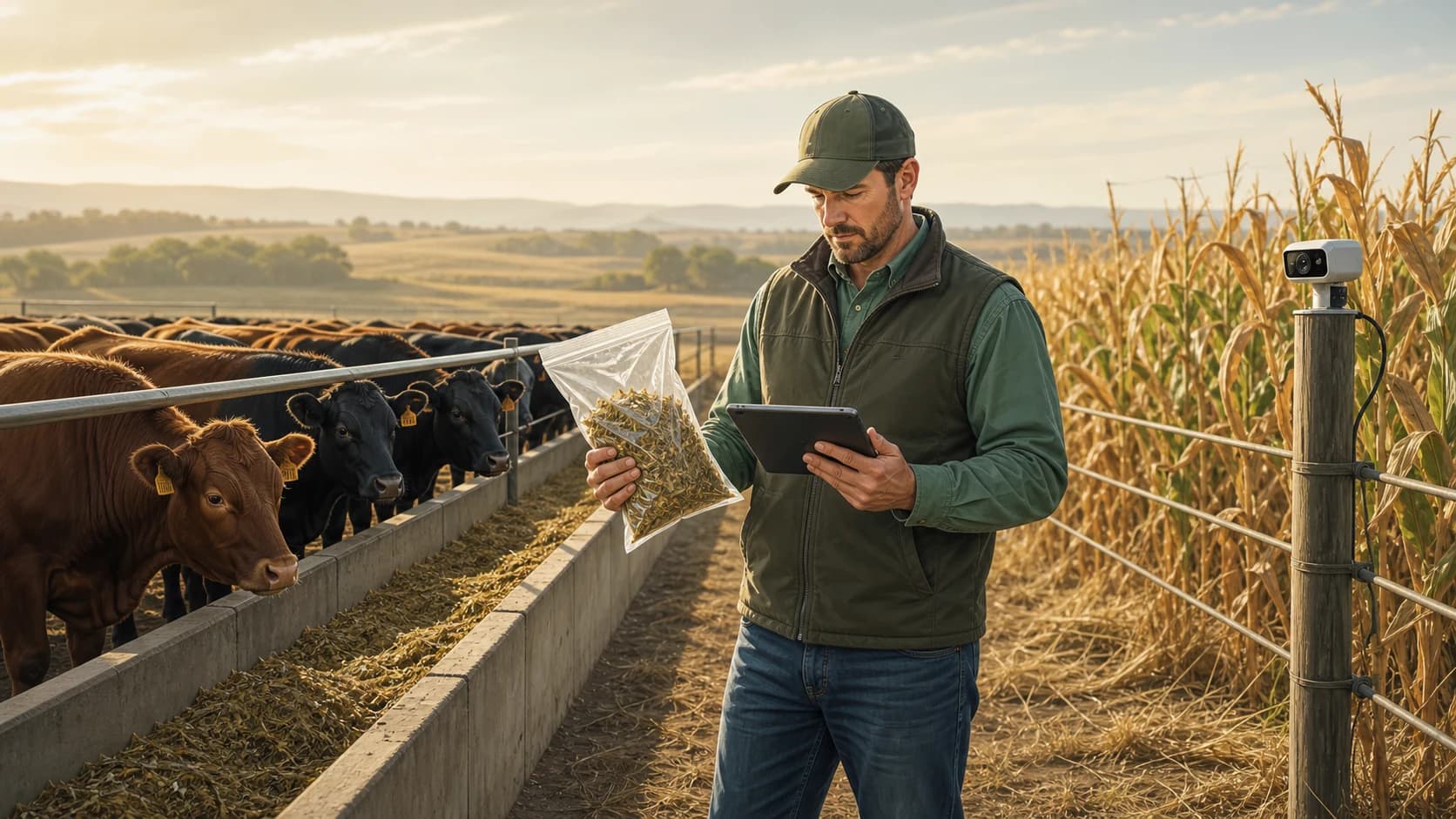
Do not feed drought-stressed forage on appearance alone. Separate the lot, collect a representative sample, preserve the laboratory result, and record the approved feeding plan.
Then connect feed delivery, the cattle group, direct checks, visible changes, and follow-up on one timeline.
Cameras can preserve bunk activity and visible behavior. They cannot measure forage nitrate, diagnose poisoning, or choose a ration.
Why drought matters
Stressed plants can hold more nitrate than cattle can safely use
Plants normally use absorbed nitrate to build proteins. Drought and other stresses can slow that process while nitrate remains in the plant.
Cattle rumen microbes convert nitrate to nitrite, then toward ammonia. Too much nitrite can limit the blood's ability to carry oxygen.
Corn, oats, barley, sorghum, sudangrass, wheat, millet, and some weeds can accumulate nitrate. Risk depends on the plant, field, weather, harvest, and feeding method.
Drought stress does not prove a forage is toxic. A representative test and qualified interpretation are the useful next steps.
Test the lot cattle will eat
One sample cannot represent every field, cutting, or storage pile
Nitrate can vary across a field and within a plant. Lower stems often carry more nitrate than leaves or grain.
Collect smaller samples across the forage lot and combine them as directed. Sample the plant parts and material the cattle will receive.
Keep separate fields, cuttings, bales, piles, and purchased loads under separate lot identities. A later test should never overwrite the earlier result.
Laboratories may report nitrate in different units and forms. Preserve the original report so a nutritionist, veterinarian, laboratory, or Extension specialist can interpret it correctly.
Five-part operating record
Keep the forage decision connected from field to cattle
Give every forage lot one identity
Record the field, cutting, harvest date, storage location, delivery, and intended cattle group. Keep different fields, cuttings, and batches separate.
Take a representative sample
Sample the material cattle will eat. Combine smaller samples across the lot, then record who sampled it, where, when, and how.
Preserve the full laboratory result
Keep the report, sample ID, units, reporting basis, laboratory, and result date. Do not copy only one number into the ration record.
Record the approved feeding plan
Name the ration, inclusion amount, dilution source, cattle group, start time, reviewer, and next check. Preserve each later change.
Watch the cattle and close the loop
Record feed delivery, bunk access, direct cattle checks, visible changes, completed actions, and follow-up. Link each exception to its source evidence.
The record card
Six lines make the decision reviewable
| Record | Keep these details |
|---|---|
| Forage lot | Field or supplier, crop, cutting, harvest, storage, and lot ID |
| Sample | Locations, method, collector, time, sample ID, and laboratory |
| Result | Reported value, units, basis, date, interpretation, and reviewer |
| Feeding plan | Ration, amount, dilution, group, start time, owner, and limits |
| Delivery | Truck or batch, pen, time, amount, and any feed change |
| Cattle review | Group, direct check, visible change, action, and follow-up time |
Watch after delivery
A feeding record needs a cattle follow-up
Record when the ration reached each pen and when cattle first had access. Keep weather, water access, handling, and other feed changes beside that time.
Current Extension guidance lists signs that need immediate attention. These include:
- rapid or difficult breathing
- weakness, tremors, or staggering
- unusual salivation or bloating
- collapse or sudden death
If nitrate poisoning is suspected, contact a veterinarian immediately. Avoid forcing affected cattle to move unless the veterinarian directs it.
Record the first observation, caller, veterinary direction, completed action, cattle group, forage lot, and follow-up. Do not assign the cause from video alone.
How Livestock Technologies helps
Put visible cattle activity beside the feed record
Livestock Technologies configures fixed cameras around pens, bunks, water zones, gates, and alleys. The system preserves time-stamped observations for the people reviewing the cattle.
A reviewer can compare feed delivery with visible bunk participation, movement, water-zone activity, and later changes. The source image or clip stays available for review.
This evidence supports a feed and animal-care record. Laboratory results, nutrition guidance, direct checks, and veterinary decisions remain the qualified controls.
The documented Tuskegee field deployment includes fixed RGB and thermal cameras, solar nodes, wireless links, and on-site processing. It proves the installed observation mechanism, not nitrate detection.
Review the feedlot inventory and movement workflow and what the cameras record before choosing pens and review windows.
Sources and current guidance
Read the guidance behind the record
- Nebraska Extension: drought-stressed corn forage and nitrate risk, August 4, 2026
- North Dakota State University: drought and livestock nitrate poisoning, August 6, 2026
- Oklahoma State University: stressed-forage toxicity and testing, August 10, 2026
- South Dakota State University: forage nitrate testing guidance, June 11, 2026
- Penn State Extension: nitrate toxicity in cattle, updated May 29, 2026
A practical next step
Start with one feed lot and one cattle group
We can map camera views, feed times, cattle groups, visible activity, exception review, and evidence retention around the records your team already uses.
Plan a focused cattle pilot