The short answer
Use a weight-and-weather estimate, not one number for every pen.
Oregon State Extension lists approximate total daily needs of 12.6 gallons at 70°F and 20.6 gallons at 90°F for 1,000-pound finishing cattle. Those estimates include water in the feed as well as drinking water. They are a starting point, not a limit on water access.
Weight, feed intake, humidity, diet, and other conditions change demand. Keep clean water available and plan the supply with your nutritionist or Extension adviser. See the Extension water table.
Hot, humid conditions can raise the requirement. Nebraska Extension gives a heat-stress planning example of 25–30 gallons a day for cattle consuming 25–30 pounds of dry matter—the feed amount with its water removed. Read the feedlot heat guidance.
From gallons to a working water system
Daily volume and refill speed answer different questions.
In an illustrative pen of 100 animals at the 90°F estimate above, total daily water need would be about 2,060 gallons. That multiplication does not tell you the right tank size or pump rate: cattle do not spread their drinking evenly across the day.
A large trough with slow refill can run short during busy periods. A smaller trough may refill quickly but offer too little drinking space. Check water supply, refill rate, and cattle access together.
USDA ARS advises checking reserves, pumps, access, and refill performance, including when several tanks share a supply line. Read its water-system checks.
See the field system
Cameras show what happens at the water area between rounds.
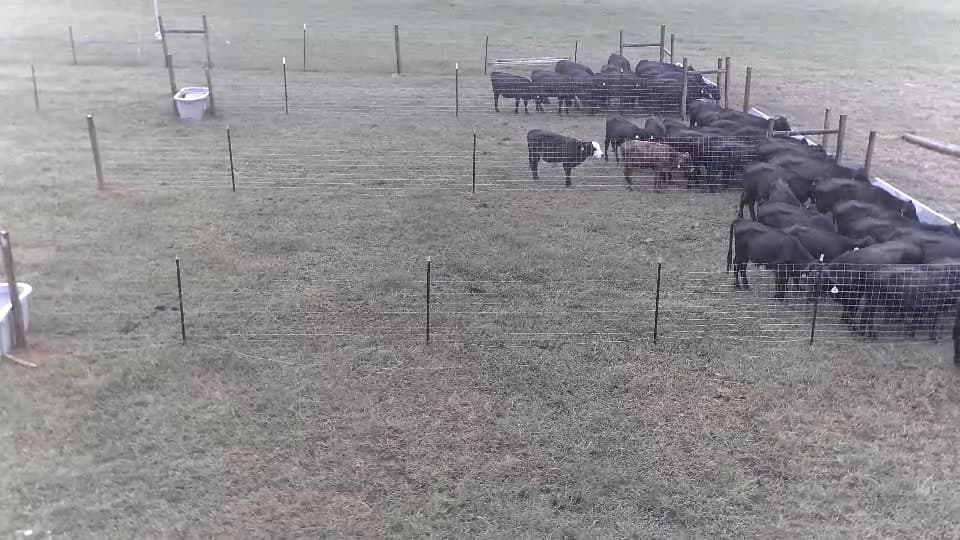
The photo above is an actual Tuskegee research-feedlot camera frame. It shows cattle at the bunk, pen boundaries, and trough locations. Our installed digital and thermal cameras preserve views through the day and night for review alongside crew checks.
Livestock Technologies helps crews review visits, crowding, and changes in visible activity. Pair that view with flow measurements and tank checks to understand the water supply.
See the installed cameras and day-and-night images →Six practical checks
Walk the system from the water source to the cattle.
01
Estimate the pen’s daily demand
Start with head count, cattle weight, feed intake, and the forecast. Ask your nutritionist or Extension adviser to help set a range for your cattle and ration, including hot days.
02
Check how fast the trough refills
Check the source, pump, pipes, valves, and float. Measure refill performance when several troughs are drawing water. A full tank at daybreak does not show whether it can keep up later.
03
Make sure cattle can reach the water
Walk the approach and exit. Look for mud, damaged footing, blocked space, or crowding. A trough can hold enough water and still be difficult for cattle to use.
04
Keep the water clean and tested
Inspect troughs for debris, algae, unusual odor, and source changes. Keep cleaning dates and laboratory results with the pen record. Clear-looking water is not a substitute for a water-quality test.
05
Review what happens between rounds
Use camera footage to review visits, waiting, crowding, and cattle being pushed away. Compare the same part of the day and note recent feeding, handling, weather, or maintenance changes.
06
Give each problem an owner
Decide who checks a low tank, slow refill, blocked approach, or unusual cattle activity. Have that person record what they found and fixed. Use your cattle-care team and veterinarian for animal-health concerns.
Where camera evidence fits
A camera shows activity. A meter measures water.
Suppose the crew sees cattle gathering at a trough. The saved camera view can help answer when the gathering started, whether animals were being pushed away, and what changed after a repair. A direct tank check and flow reading help explain whether the supply was keeping up.
Time near a trough is not the same as gallons consumed. A camera gives the crew a record of visible activity; measuring individual intake needs a suitable intake-measurement system.
For a useful camera installation, frame the drinking area and its approaches, check the view under changing light, and decide who reviews unusual activity. The aim is a clearer next field check, not another screen for the crew to watch all day.
Shift-ready checklist
Leave the next shift a short, useful handoff.
- Which pen or trough needs another check, and when?
- What did the crew measure or see? Include the time and any useful camera clip.
- What was cleaned, repaired, or changed?
- Who owns the next check, and who should they call if the problem continues?
For feedlot teams
Want to see what happens at your troughs between rounds?
Tell us your cattle and pen count, where the troughs sit, and the activity your crew wants to see more clearly. Livestock Technologies can map camera views and a practical review process around your current water checks. A pen map or a few site photos are useful; a finished technical plan is not required.
Sources and current guidance
- University of Florida IFAS: Water Nutrition and Quality Considerations for Cattle
- Oregon State University Extension: Water Nutrition and Quality for Beef Cattle
- USDA Agricultural Research Service: Actions to Minimize Heat Stress
- University of Nebraska-Lincoln: Meeting Water Needs of Cattle in the Feedlot