The short answer
A useful system makes one feedlot job easier to verify. It shows what was recorded, what was missed, how the result connects to the yard record, and who must act.
Do not buy a dashboard before defining that job. Ask for a pilot that can succeed or fail against written measures in your yard.
Start with the cattle decision, not the device
A feedlot can collect counts, electronic identification, movement events, weights, treatments, images, and sensor readings. More data does not automatically create a clearer decision.
South Dakota State University Extension makes the same practical point about high-data livestock systems. The useful step is connecting information to a defined management question.
For Livestock Technologies, a strong starting job is observed pen inventory. Cameras preserve repeated evidence, while the yard record states what should be in each pen.
The crew reviews the difference, checks known movements, and closes the exception. The camera does not replace the yard file, EID or RFID, or direct cattle care.
Eight questions every feedlot buyer should ask
01
What cattle decision must the system support?
Name one operating job, such as reconciling pen inventory or reviewing an unexplained movement. A broad promise is not a pilot plan.
02
What does the equipment directly record?
List each camera, covered area, timestamp, file, and observation. Keep direct evidence separate from software estimates and staff conclusions.
03
How are blind spots and missing periods shown?
Ask the system to mark blocked views, stale images, clock errors, outages, and uncertain observations. Missing evidence must remain visible.
04
How does it fit the records you already use?
Map yard software, EID or RFID, processing, treatment, movement, shipment, and camera records. Decide which source controls each field.
05
How will you test it in your yard?
Use reference counts, known movements, named reviewers, and written operating conditions. Agree on acceptance measures before installation.
06
What continues when a connection fails?
Separate camera capture, local recording, processing, remote access, and alerts. Document what stops, what continues, and how gaps are recovered.
07
Who controls data, updates, and access?
Write down ownership, authorized roles, retention, exports, backups, software updates, support access, and the response to a security problem.
08
Who closes an exception and supports the system?
Assign a person to review each cattle difference. Define response times, maintenance ownership, spare parts, training, and end-of-support terms.
Make each record keep its own job
A connected system does not make every source interchangeable. Define which record answers each question and how staff resolve a conflict.
| Source | Primary job |
|---|---|
| Yard software | Expected cattle inventory, lot assignments, treatments, processing events, and documented movements. |
| EID or RFID | An official or operation-approved electronic identifier at a controlled read point. |
| Fixed cameras | Time-stamped visual evidence of cattle presence, location, movement, and activity in covered areas. |
| People | Direct animal checks, record corrections, health decisions, exception closure, and accountability. |
USDA APHIS explains that individual cattle identification supports weight, treatment, movement, and disease-traceback records. RFID can move an electronic number into a database at a read point.
Fixed cameras add visible place and time between controlled reads. They cannot assign an official identity or prove a treatment, weight, diagnosis, or final disposition.
Require a pilot with reference checks
A good demonstration shows that equipment turns on. A useful pilot shows whether the full workflow supports the named cattle decision under actual yard conditions.
A 2026 University of Nebraska–Lincoln sensor study compared device alerts with clinical observations and recorded treatments. That separation between system output and reference evidence matters.
Use direct counts and known movement events for an inventory pilot. Preserve the source files, operating conditions, reviewer decisions, corrections, and unresolved cases.
- 1
Choose one job
Start with one result the crew already needs, not every possible camera use.
- 2
Freeze the baseline
Keep the current pen map, expected counts, movement rules, record owners, and time standard.
- 3
Map coverage
Record each camera view, blind spot, lighting condition, gate, bunk, water zone, and outage state.
- 4
Connect the records
Define how observations reference pens, animals, movements, EID or RFID, and the yard file.
- 5
Run reference checks
Compare system output with direct counts and known events under written operating conditions.
- 6
Practice a failure
Test stale images, lost remote access, missing capture, recovery, and the crew handoff.
- 7
Review the evidence
Measure the agreed job and inspect misses, false matches, review time, and unresolved cases.
- 8
Decide with exit criteria
Expand, revise, or stop according to the measures agreed before the pilot began.
Ask what happens after installation
Field equipment needs maintenance, updates, access control, storage planning, backups, and a known support path. The agreement should name both customer and vendor responsibilities.
NIST opened a new review of its IoT device cybersecurity requirements on August 31, 2026. Its notice highlights changing device uses, component deployments, and the need for current security guidance.
Federal IoT guidance is not a cattle-production rule. It still offers useful questions about device identity, configuration, data protection, updates, event awareness, documentation, and support.
Ask how long equipment and software will be supported. Confirm how updates are authenticated, how access is removed, and how records can be exported before a service ends.
Use field evidence without stretching the claim
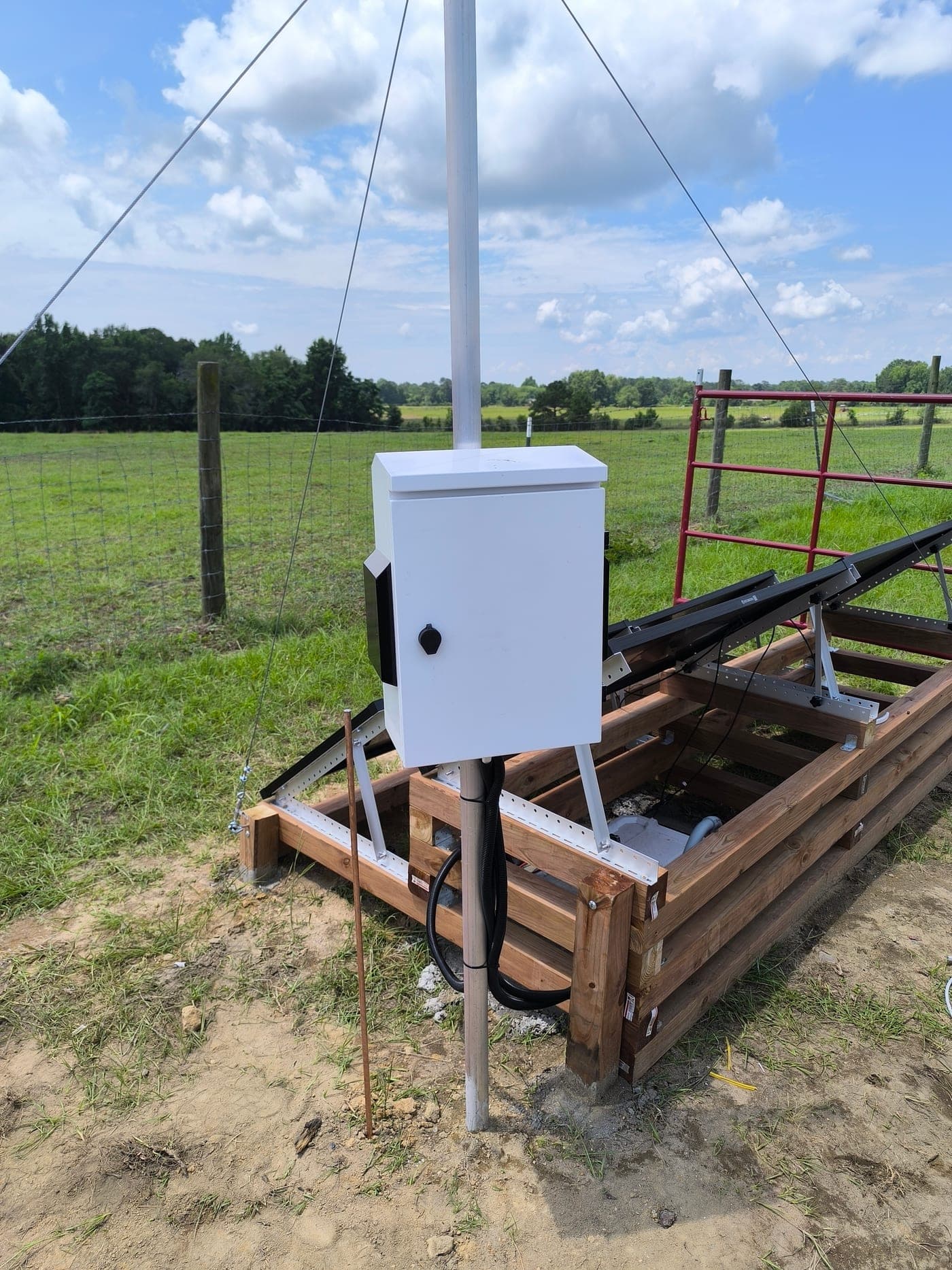
Livestock Technologies has installed fixed RGB and thermal cameras across four research pens at Tuskegee University. The field build includes solar nodes, wireless links, and on-site processing.
RGB means visible-color imagery. Thermal cameras record surface-temperature patterns, which require their own qualified interpretation and validation for any research or animal-care use.
The Tuskegee deployment documents working field infrastructure and continuous capture. It does not establish commercial savings, perfect coverage, diagnostic accuracy, or a feedlot-wide performance rate.
Review the installed field system, explore the camera platform, and see feedlot inventory workflows.
Sources and further reading
- USDA APHIS: Beef Feedlot 2021 Study — Animal Identification
- South Dakota State University Extension: Feed Management in a High-Data Livestock Industry
- University of Nebraska–Lincoln: Evaluation of a Remote Sensing Tag in Newly Received Steers
- NIST: Call for Comments on the IoT Device Cybersecurity Requirement Catalog
- Livestock Technologies: Tuskegee University Field Deployment
Bring one cattle decision and your current records
We will map the camera views, expected counts, movement records, review owners, field constraints, and acceptance measures around one practical feedlot pilot.
Review a feedlot monitoring pilot