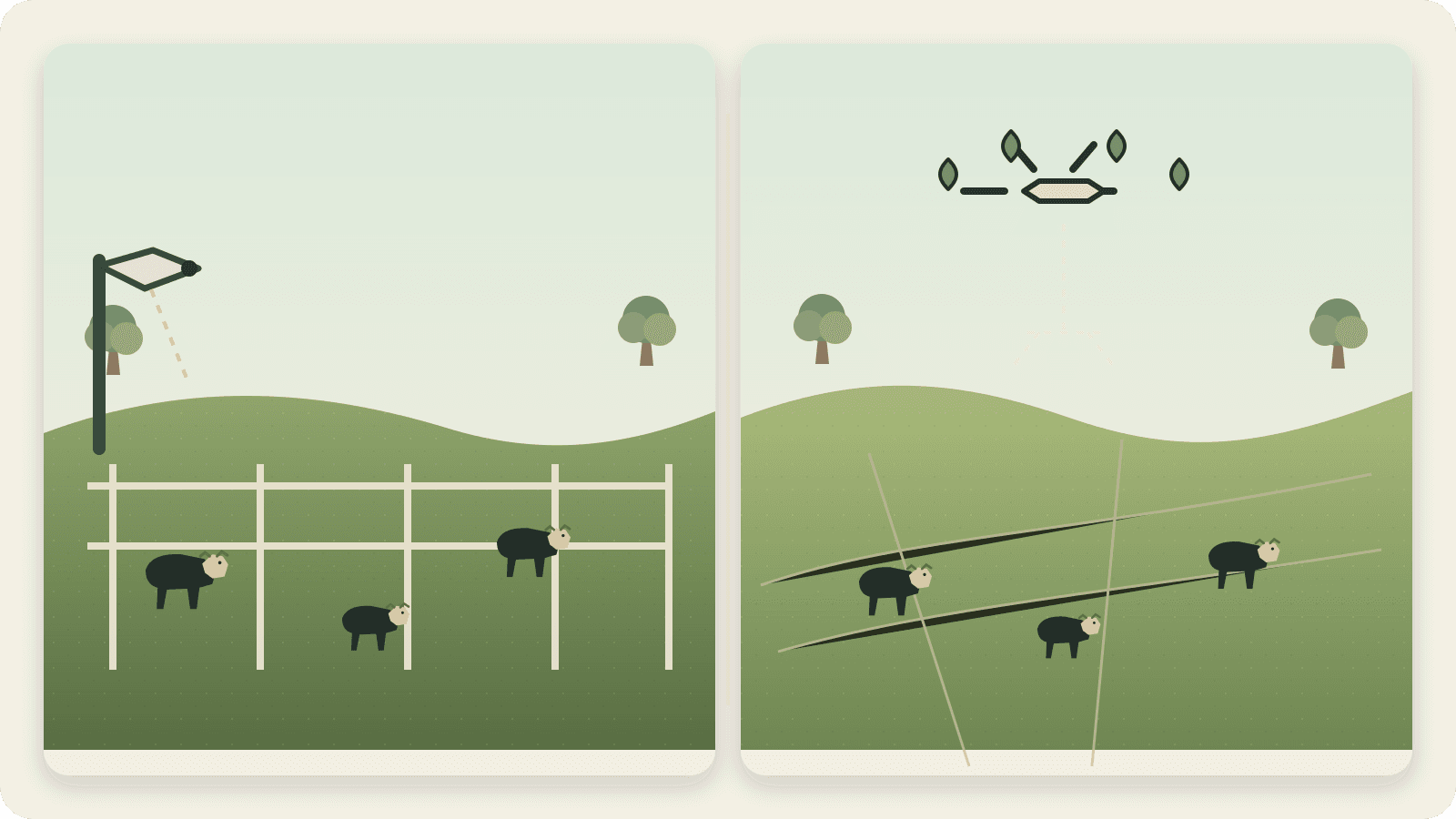
What does each view help you observe?
A fixed camera keeps a stable view of a defined space. That can help a team revisit the same pen or location across time and compare visible events against a study schedule.
A drone can move its vantage point across more open ground. That is useful when the study question is about the wider area or unconfined cattle, but each observation is tied to its flight, view and collection conditions.
| Study need | Fixed camera view | Mobile aerial view |
|---|---|---|
| Best starting question | What is visible in this known pen or location over the planned observation period? | What is happening across a wider area or along a route? |
| Strength of the view | Repeatable angle and place for comparing time-linked scenes. | Flexible vantage point for broader spatial coverage. |
| Plan around | Frame boundaries, overlap, lighting and whether the study needs individual identification. | Flight timing, changing view and the distance/detail needed for the study question. |
Neither view measures every outcome on its own. A research team should name what the camera or flight can show, then specify the independent reference needed to evaluate the study outcome.
See a fixed camera view from the Tuskegee field site
Livestock Technologies has installed fixed digital and thermal camera views around four cattle research pens at Tuskegee University, with field nodes, wireless connectivity, and on-site processing and storage. Here is an actual RGB camera frame from that installation.
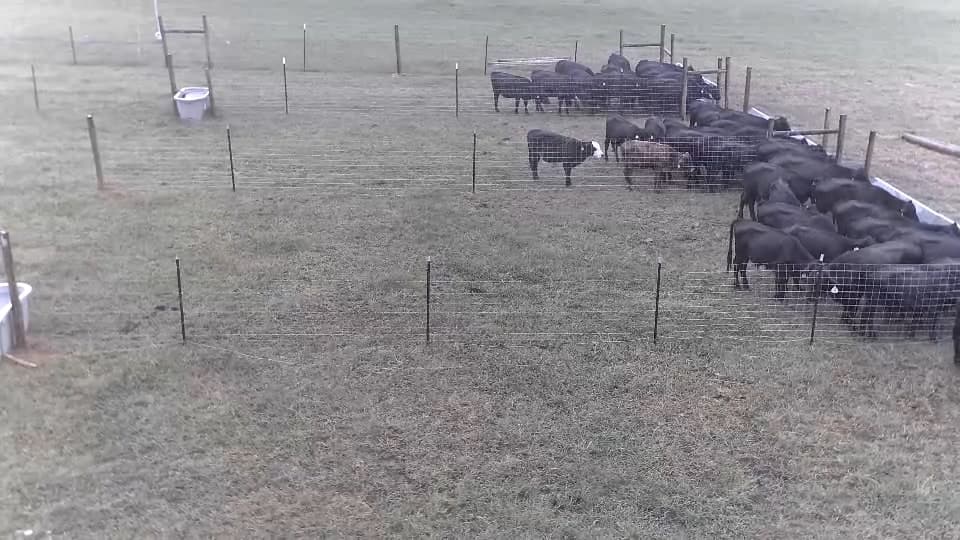
A researcher could use a defined camera view to examine when cattle are visible in a selected pen area. If the study asks how much each animal consumed, a separate intake measure is still needed; visible bunk presence is not the same as feed consumed.
The Tuskegee field report shows the installed research platform, while the shareable research capabilities brief summarizes the questions a campus team can scope.
Why research teams are combining views and methods
A USDA NIFA project report dated October 1 lists an active University of Kentucky Research Foundation project using cooperative drones and photogrammetry to study monitoring and herding unconfined cattle. It is a separate research project, but it illustrates why some cattle questions call for mobile observation across a broader area.
Other movement studies show the value of pairing image-based observations with a reference method. The University of Illinois's 2026 cattle-motion project describes markerless 3D imaging alongside a marker-based reference approach. The University of Tennessee's precision-livestock conference program also highlighted validation and field implementation as research topics.
These examples point to a practical design question: what should be visible, where and when, and what independent record will tell the team whether the observation answers its question?
Plan a useful comparison before collection starts
Suppose a campus team wants to study where cattle gather during a specific part of the day. A fixed view may suit a defined pen area; a mobile aerial view may suit movement across a larger open space. The team can compare a sample of observations from the same period, record which areas and animals are visible, and have trained reviewers check the output against the agreed observation method.
Before selecting equipment, write down the outcome, observation area, time window and unit of analysis—an individual animal, a group or a pen. Then decide what outside measurement or human-coded reference is needed. A short design conversation can expose a mismatch before the study commits to a data-collection plan.
For more background, see the USDA NIFA project record, the University of Illinois cattle-motion report and the University of Tennessee precision-livestock program.
Bring the study question
Plan the view around the cattle question.
We can show the documented Tuskegee camera platform and discuss whether a fixed-camera research scope fits your team's site, observation area and reference measurements.
Discuss a university research scope →