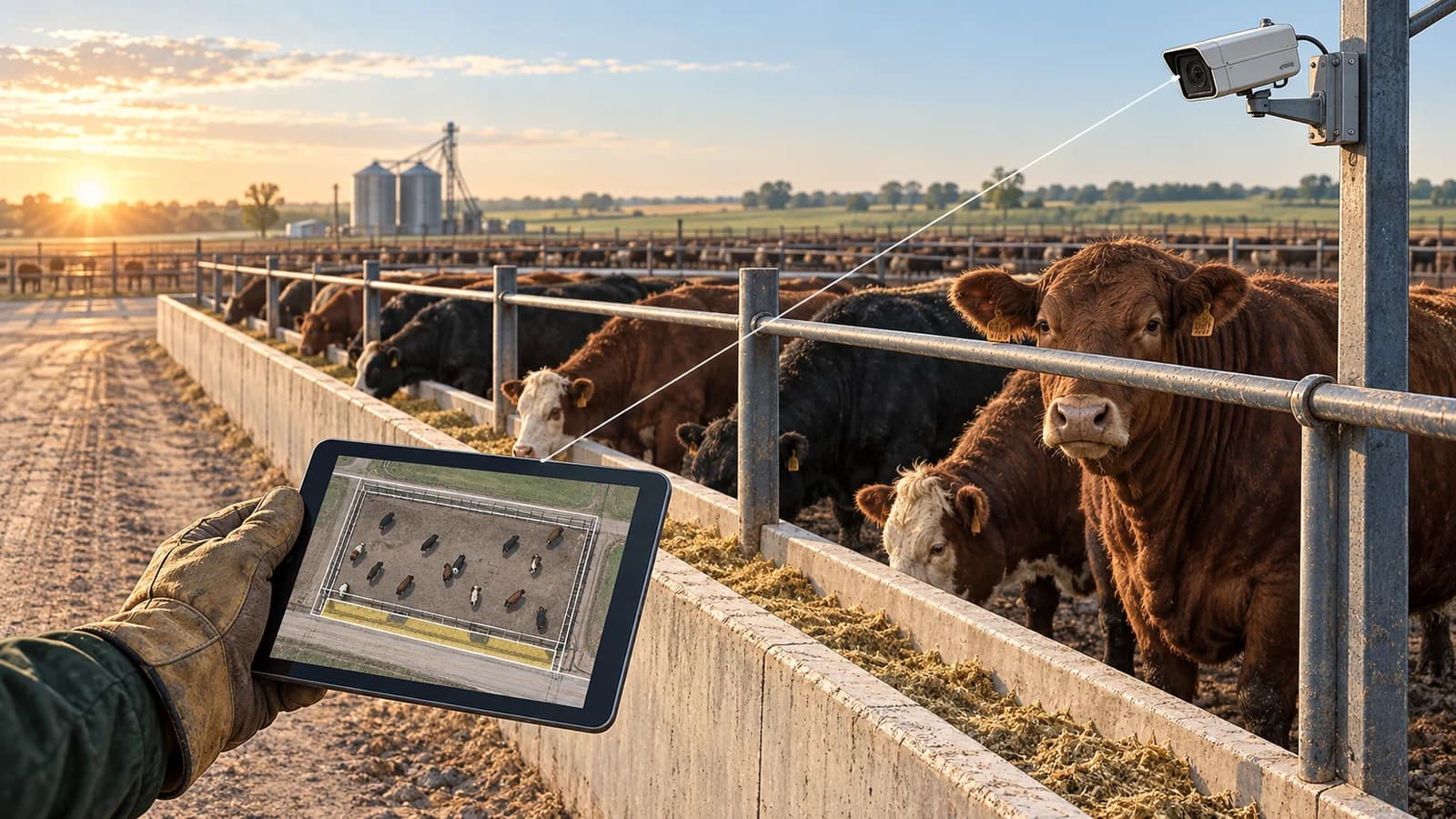
Start with a real field view
The useful question is what happens between your rounds
The Livestock Technologies installation at Tuskegee University records four research pens with 60 cattle. Fixed color and thermal cameras connect to on-site processing and storage.
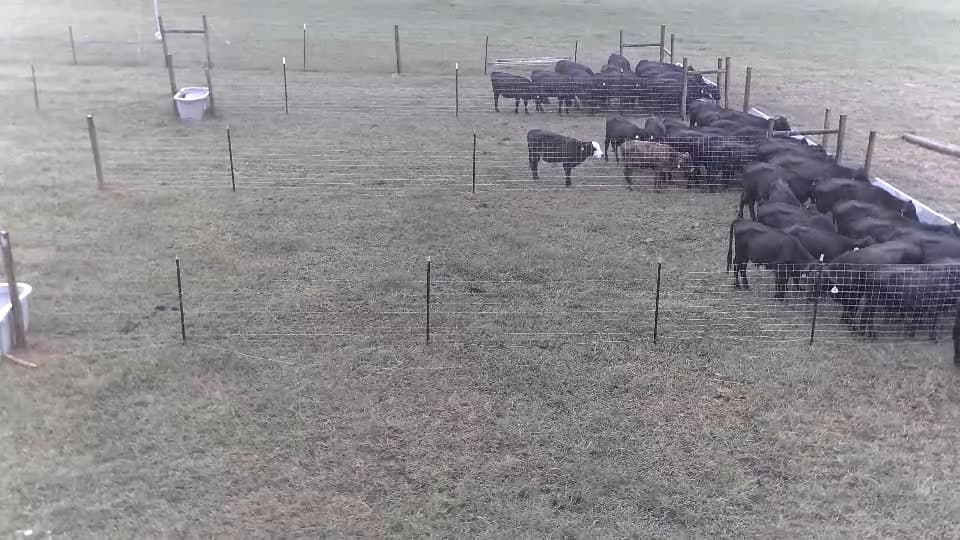
In the frame below, cattle are gathered along the bunk. A single image shows their position. A time-based cattle monitoring workflow can help a crew review how that activity changes across the covered period.
Recording the yard and monitoring cattle are different jobs
Security video is useful for gates, equipment, deliveries, and reviewing an incident. Modern systems can also run sophisticated analytics. The question is whether those analytics answer your cattle question.
For example, AXIS Object Analytics documents rules for people, vehicles, and movement in selected areas. Those are valuable security functions. They are not, by themselves, a cattle behavior monitoring program.
What does the crew look for?
Video recording
A person opens the live view or searches recorded footage.
Cattle-specific monitoring
Cattle observations are organized by pen, time, and the activity the yard wants to review.
What does an event mean?
Video recording
Movement, a person, or a vehicle may trigger a security rule, depending on the system.
Cattle-specific monitoring
The system is set up around cattle and defined zones, such as the bunk, water area, or pen.
What supports the next decision?
Video recording
The footage shows what was visible to that camera.
Cattle-specific monitoring
Time-linked observations help the crew find and compare the relevant source imagery.
What happens when the view is blocked?
Video recording
The recording may continue even though the required detail is no longer visible.
Cattle-specific monitoring
Coverage and uncertain observations belong in the review, so a missing view is not mistaken for normal activity.
What Livestock Technologies adds
Our platform combines fixed camera views, cattle-focused computer vision, and on-site processing. It turns pixels, position, and time into reviewable observations about cattle presence, movement, and activity within the monitored area.
For a feedlot crew, that can mean reviewing bunk activity, water-zone use, resting patterns, or movement during a chosen period. The source imagery stays part of the conversation, so the team can see what sits behind an observation.
Computer vision is software that finds and follows useful features in images. It can use learned models along with geometry and rules. The practical value is the cattle question it helps answer, not the label “AI.”
University of Georgia Extension makes the same basic distinction in its dairy-camera research: capturing video and extracting useful behavior information are separate tasks. That research is background on the method, not a performance result for our system.
An example from the workday
“Did this pen come back to the bunk?”
Suppose the crew wants to review bunk activity after a feed delivery. With video alone, someone finds the right camera and watches the relevant period.
With cattle-specific monitoring, the same question starts with the pen, bunk zone, and time window. The crew reviews the activity observations and opens the source imagery where it needs more context.
A quiet period can then be compared with the delivery time, normal routine, camera coverage, and what the crew saw in person. The next step might be a bunk check or a closer look at the cattle.
Time near a bunk is not the same as pounds of feed eaten. The observation helps focus the check; the feed record and direct inspection answer the next question.
Illustrative operating example, not a reported customer outcome.
Can you use the cameras you already own?
Possibly. Start by showing us the camera model, a normal daytime view, a nighttime view, and the pen area you want to monitor. Existing equipment may be useful, but fit depends on the actual stream and scene.
A wide yard view may be excellent for security while leaving cattle too small for the detail you need. A rotating camera can leave the bunk out of view. A lens aimed at a gate may not cover the water area.
We review placement, image detail, lighting, stream access, power, network, and retention together. The goal is to keep useful equipment and fill the gaps that matter, not assume every camera must be replaced.
Ask for one complete demonstration
Pick a real pen question. Ask to see the camera view, the resulting cattle observation, the source footage, and the person's next step. That shows more than a camera specification or a screen full of boxes.
A practical next step
Bring us one pen and one question
Tell us what you need to know between rounds and what cameras you have today. We will help map the view, observations, and crew workflow for a useful first deployment.
Discuss your feedlot camera setup“Never lose an animal” begins with useful attention to the cattle entrusted to your care.