The short answer
Screwworm is a fly whose larvae invade wounds and feed on living tissue.
For a cattle operation, the practical job is to find a suspicious wound early, protect the animal, alert the veterinarian and animal-health authorities, and preserve the first observation plus the animal's recent movement and handling record. USDA APHIS directs suspected animal cases to be reported immediately. The response team determines identification, treatment, movement controls, and follow-up under current guidance.
Why this question is current
U.S. cattle crews are searching for a direct operational answer
USDA confirmed New World screwworm in a Texas calf on June 3, 2026, the first confirmed U.S. livestock detection in decades. USDA and state partners now maintain current status, reporting, and response resources for livestock owners and veterinarians.
For a cattle crew, the immediate concern is practical: notice a suspicious wound early, keep the animal and movement record together, and contact the operation veterinarian and animal-health authorities without losing time or evidence. Independent Associated Press reporting in late July also described U.S. cases and USDA's planned phased reopening of the Douglas, Arizona, cattle port.
This article answers the operator question. The existing RGB and thermal wound-review article remains a research-study protocol, while the cattle-port article covers receiving and inventory preparation.
What crews inspect
Start with wounds, body openings, and a change that deserves a closer look
New World screwworm flies lay eggs at wounds or body openings. Extension inspection guides direct cattle owners to look for larvae in a wound, an enlarging or deepening wound, drainage, odor, bleeding, and irritation or behavior that draws attention to the site. Recent processing, surgery, calving, dehorning, branding, insect bites, and ordinary cuts all create body locations that need an assigned check.
A useful inspection record is specific: animal or group, pen, body region, original time, who saw it, what was visible, and what happened next. That record lets the next person review the same site and gives the veterinarian or official responder a clean starting point.
The useful first message
“Animal 1847 in hospital pen 3 has a wound at the left shoulder. Larvae were visible at 6:40 a.m. The animal arrived July 28, moved from receiving pen 12 yesterday, and the original image is preserved.”
A short source-linked message is more useful than a broad alert with no animal, place, time, or movement context.
Feedlot response workflow
Six steps from inspection to a documented closeout
Assign the inspection route
Name who checks receiving cattle, hospital pens, fresh processing sites, newborns, and animals with recent wounds. Record the date, time, pen, animal identifier when available, and body region inspected so the next check starts from a known point.
Isolate and alert the response team
Move a suspected animal only as your veterinarian or animal-health authority directs. Contact the operation veterinarian, state animal health official, and USDA APHIS through the current reporting channel. Fast escalation gives qualified responders the earliest useful look.
Preserve the source record
Keep the original crew observation, animal and lot records, receiving and processing times, treatment records, pen moves, transport history, and people who handled the animal. Avoid replacing the first observation with a later summary.
Retain reviewable visual evidence
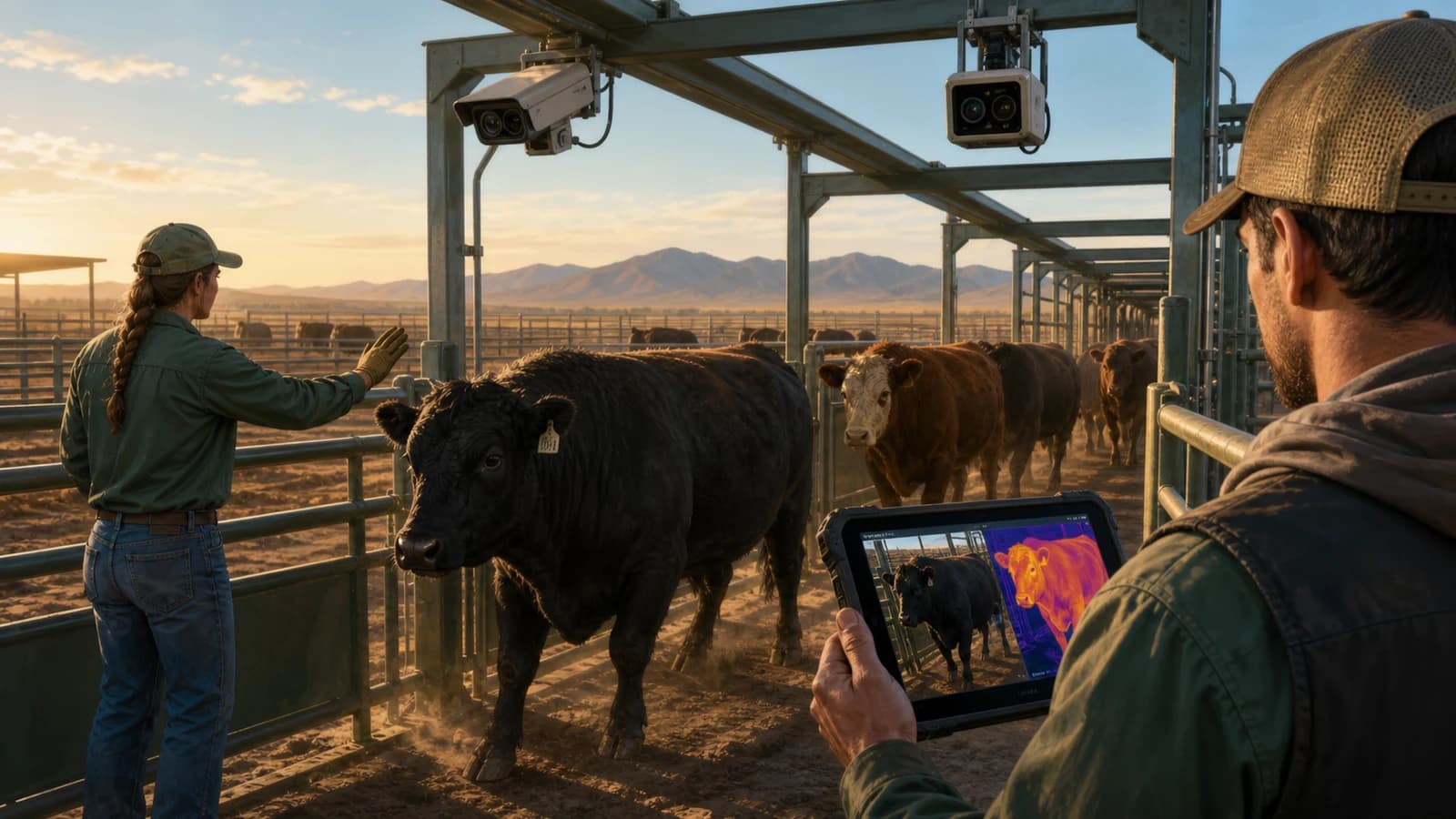
Preserve clear digital images or video, the original timestamp, body location, capture distance, and visibility conditions when the response team requests them. If thermal imagery is available, retain it beside the corresponding color view and ambient context.
Reconcile movement and contact points
Trace the animal from arrival through processing, pens, hospital areas, loading points, and recent handling. Compare the expected record with observed movement and write down every unresolved exception instead of assuming the route was complete.
Close the loop under official guidance
Record the qualified finding, response instructions, affected locations, cleaning or handling actions, movement restrictions, follow-up inspections, and who cleared each step. Preserve the evidence packet for the operation and any required investigation.
Evidence roles
Give each record a defined job in the response
Crew inspection
Strongest for: Current wound appearance, animal condition, and immediate care needs
Response handoff: Starts the qualified veterinary and official response
RGB images and video
Strongest for: Visible body region, wound change, drainage, insects or larvae, and capture context
Response handoff: Preserves what was visible for review and follow-up comparison
Thermal imagery
Strongest for: Surface-temperature patterns under documented distance and environmental conditions
Response handoff: Adds a second review channel beside the color image
Movement and yard records
Strongest for: Arrival, processing, pen, hospital, transport, and handling timeline
Response handoff: Supports traceback, contact-point review, and exception reconciliation
Where Livestock Technologies fits
Preserve the time, place, movement, and paired camera view
Livestock Technologies builds fixed-camera workflows for commercial feedlots and animal-science researchers. At a receiving lane, processing area, hospital route, or controlled chute, digital and thermal capture can preserve what was visible during a registered passage. Pen cameras can add reviewable time-and-place evidence around movement and visible behavior.
The operational value is the evidence packet: original files, animal or candidate identity, pen and passage, body-region visibility, image quality, camera and protocol version, reviewer decision, and a link back to the yard record. Low-confidence identity, missing views, and occlusion stay explicit for human review.
Camera evidence supports inspection, documentation, and escalation; the veterinarian and official animal-health response determine the cause and care plan. That boundary keeps the technology focused on the work it can do well: help responsible people find and review the right evidence quickly.
See the observed animal and pen workflows and the Tuskegee University field deployment that documents 4K digital, thermal, on-site compute, and research infrastructure in a real cattle environment.
Readiness check
Questions to settle before the next suspicious wound appears
- Who owns daily wound inspection at receiving, processing, hospital pens, calving areas, and recent procedure sites?
- Which veterinarian, state animal-health office, and USDA APHIS reporting contacts are posted for every shift?
- Where can a suspected animal be held under veterinary or official direction without losing its source identity?
- Can the team retrieve the animal, lot, transport, processing, treatment, pen, and movement timeline quickly?
- Which RGB, thermal, chute, and pen-camera records can be preserved with original timestamps and visibility states?
- Who reviews unresolved identity, missing coverage, and expected-versus-observed movement exceptions?
- How are official findings, care instructions, movement controls, follow-up checks, and clearance retained?
For cattle operations
Map the evidence handoff before an urgent inspection.
Bring us the handling map, camera locations, cattle and pen identifiers, movement records, wound-check points, escalation owners, and review requirements. We will help define a bounded RGB, thermal, and movement-evidence workflow that complements your veterinary and official response plan.
Sources and current guidance
- USDA APHIS: confirmed U.S. New World screwworm detections
- USDA APHIS: report a suspected New World screwworm case
- Texas A&M AgriLife: what to do if you suspect screwworm in a herd
- University of Arizona: livestock inspection guide for New World screwworm
- Associated Press: U.S. cattle-port reopening and current screwworm context
Published August 3, 2026. Outbreak status, reporting channels, response instructions, treatments, movement controls, and sample handling can change. Use the current USDA APHIS, state animal-health, and veterinarian guidance for the operation and animal in front of you.