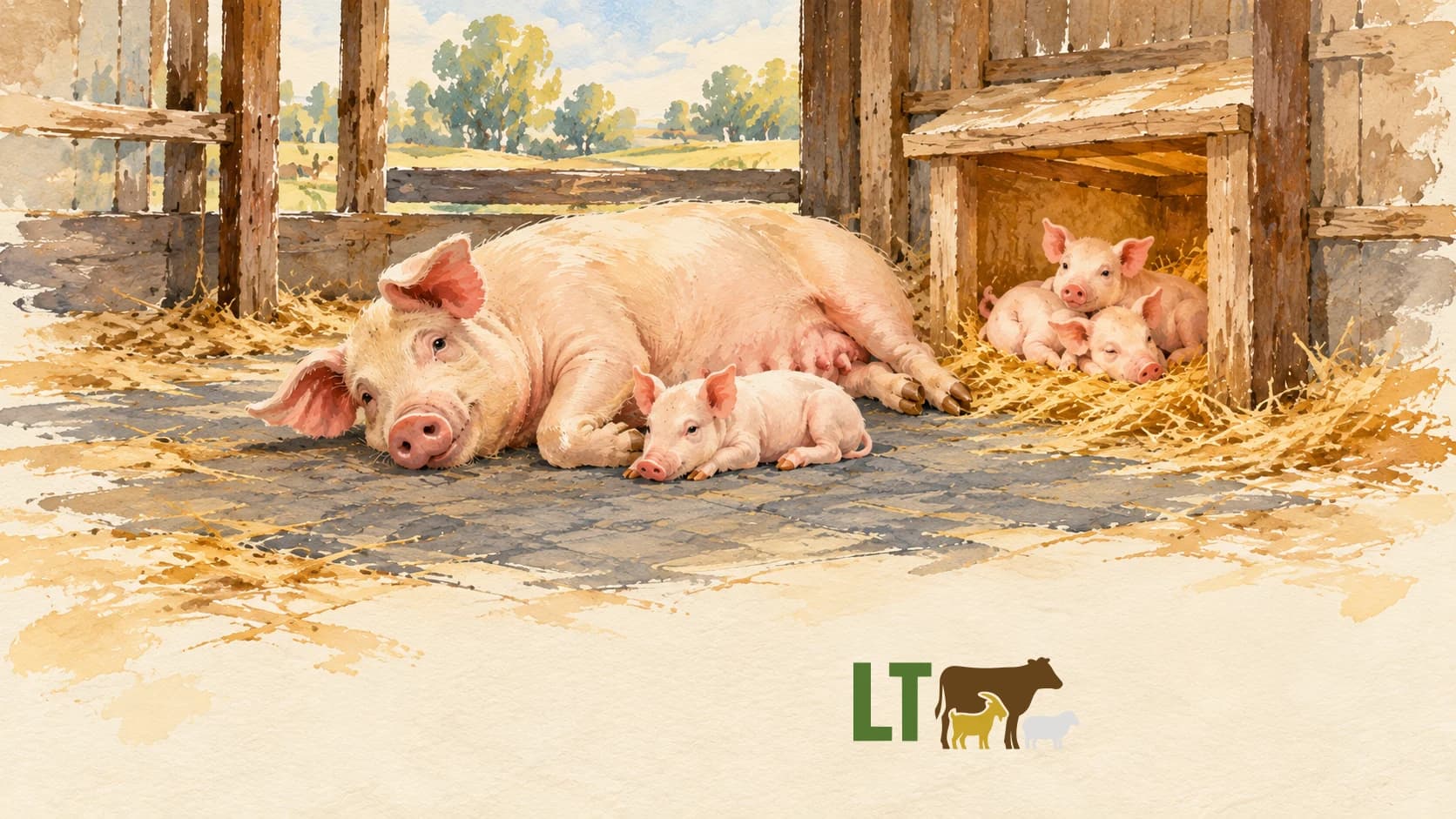
One pen holds two different needs
Newborn piglets arrive wet, with little insulation and a limited ability to control their body temperature. The American Society of Animal Science's summary of piglet housing research explains why their immediate surroundings need careful management.
A mature sow faces a different challenge. She produces heat while supporting a nursing litter. University of Minnesota Extension notes that ideal temperatures fall as pigs grow larger, and that heat stress can reduce a sow's feed intake and milk production.
Warming the whole room for the smallest animals can therefore make conditions less suitable for their mother. Cooling the room alone does not describe the protected warmth available to the litter. The practical answer is to think in smaller spaces.
Give warmth and cooling their own places
A piglet microclimate is the local environment around the piglets, rather than the average conditions in the room. A creep area is a resting space the piglets can enter while the sow remains outside. Its warmth, dryness and usable space matter together.
Purdue researchers approached the other side of this problem by cooling the sow where she lies. The university's February 2022 report describes a sow-sized metal pad above pipes carrying circulating water. Heat moves from the sow into the pad and water, while piglets stay off the pad's edge when feeding.
That design illustrates a useful principle: direct the cooling toward the animal that needs it. It does not require the whole pen to become the sow's cooling surface.
A working prototype is the start of a research question
A March 3, 2026 Scientific Reports paper describes another approach. Its researchers built a cooling mat that chills circulating water with electrically powered cooling modules. It was designed to work without an external supply of cool water.
The team tested the equipment in a chamber and in small farrowing-room trials. The trials lacked the replication needed to draw firm conclusions about sow and litter performance. The authors called for a larger study.
The distinction matters when a university considers new equipment. Showing that a pad removes heat answers an engineering question. Showing how mothers and litters respond over time requires animal measurements and a suitable study design.
Watch the journey between resting and nursing
Imagine a university comparing two approved piglet resting-area layouts beside the same type of sow cooling pad. Both layouts provide warm space. One places the entrance close to the nursing side; the other changes the route the litter takes.
The research question is whether piglets use the resting space and move between it and their mother as intended. Video could help the team revisit where piglets rest, when they leave and whether the entrance becomes crowded. This is a proposed example, not a reported trial result.
A single room thermometer cannot describe all those movements or every local thermal condition. Environmental measurements should describe the sow's area and the piglets' area separately. The research team can then compare space use with its chosen measures of animal comfort, nursing and growth.
A cluster of resting piglets is useful to observe, but it does not explain its own cause. Interpret the pattern with local conditions, piglet age, the time since nursing and direct animal-care observations. The care team should set the heating and cooling plan for the animals involved.
Make the whole pen visible to the research team
Livestock Technologies works on the infrastructure behind sustained animal observation: fixed camera views, connectivity, processing and access to source footage. A university farrowing project can start by identifying the sow's resting area, the piglet space and the path between them.
From there, we can discuss a custom camera and data scope that lets collaborators return to those places at the times their study needs. The cameras supply visual context alongside the university's environmental and animal measurements. This is research infrastructure to scope, not a company cooling-pad product.
Our documented field work, technology overview and university capabilities brief show how we approach observation systems. The aim is a useful view of the animals' shared space, rather than a room average standing in for the whole story.
Never lose an animal.
Which part of the farrowing pen does your study need to see?
Bring the housing layout, the animal question and the observations you need over time. We can discuss a practical research camera and data scope.
Discuss a swine research project →