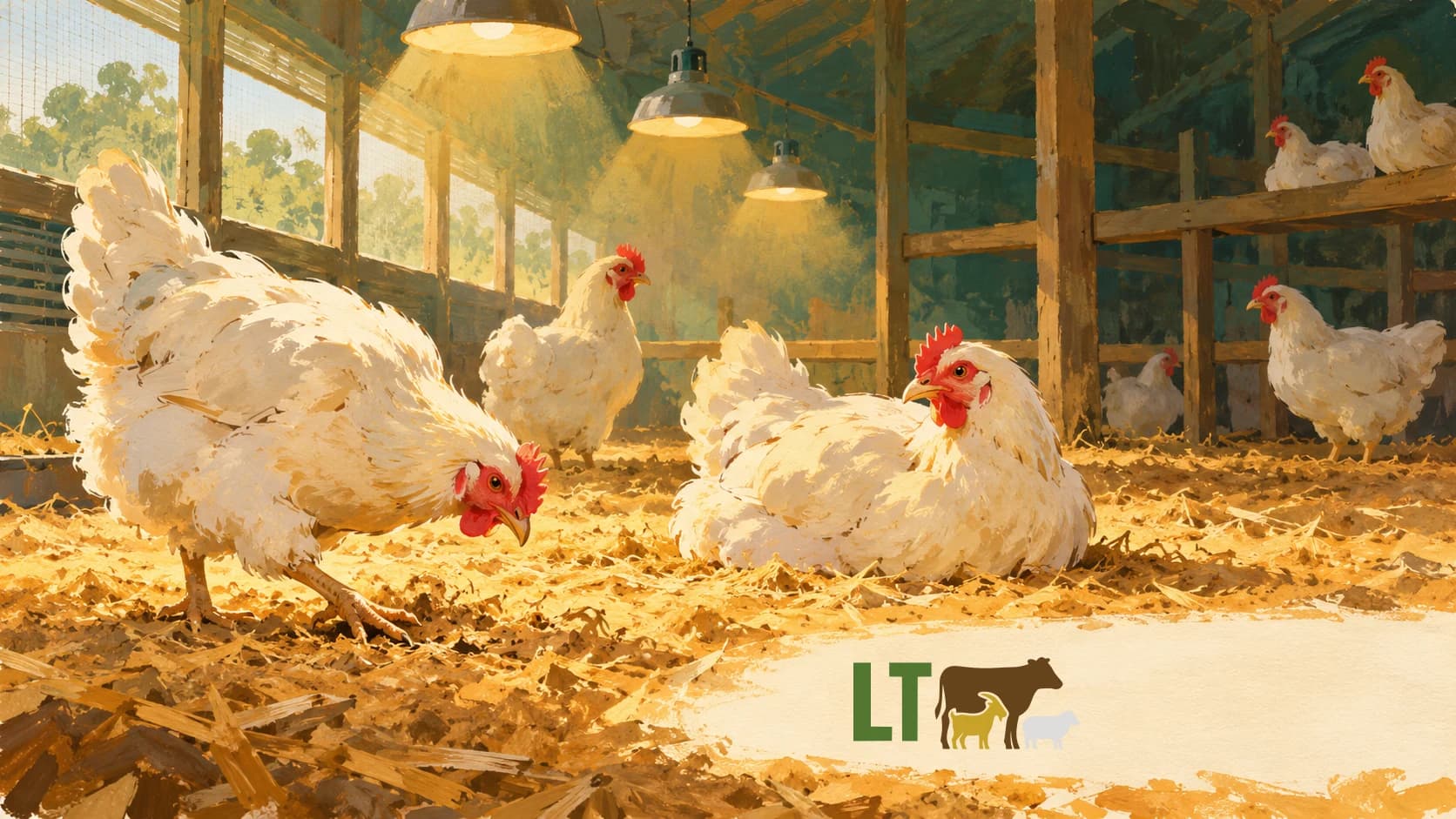
A hen sees more than a well-lit room
Walk into a poultry house and the lighting may seem perfectly ordinary. The birds may experience it differently. Color, brightness and the hours of light each day all matter.
The University of Kentucky's poultry lighting guide explains that chickens can respond to wavelengths outside human vision. Two lamps that look similar to us may therefore create different conditions for them. Light also helps regulate daily and reproductive patterns.
For researchers, that makes lighting part of the animal's environment. It deserves the same attention as the feeder, housing or treatment being studied. A room that looks consistent to a person is not automatically a consistent setting for birds.
What an October extension report reminds us
In an October 5, 2026 extension article, University of Georgia poultry specialist Casey Ritz describes lighting as a management tool for behavior, growth and egg production. The article focuses on small and backyard flocks, including the importance of matching lamps with compatible dimmers and timers.
Its practical message for a university team is broader than choosing a bulb. A light source is an experimental condition. Advice for a small laying flock should not be copied into a commercial broiler study as a universal lighting schedule.
The animal-care team should set the appropriate program for the birds and research question. The observation system should then work within that program, rather than changing it simply to make pictures look brighter.
The camera has its own response to light
A camera does not see a scene in the same way as a hen. Its exposure settings control how light becomes an image. Exposure time means how long the sensor gathers light for each picture.
Longer exposure can brighten a dim scene but blur a moving bird. Electronic amplification can make dark details easier to see while adding image noise—the grainy speckles in a recording. Axis's camera documentation explains these tradeoffs and how automatic settings respond to changing light.
This creates two separate questions. Did the birds change what they were doing? Or did the recording become better or worse at showing the same movement? Clearer footage helps observation, but it does not by itself demonstrate a biological improvement.
Picture a study comparing two lighting programs
Imagine a university comparing hen activity under two approved lighting programs. A student sees fewer walking events in the dimmer room. That could be a useful finding, but the team first needs to know whether walking remains equally visible in both recordings.
If moving birds become blurred in one room, a person or software may miss events there. A short comparison with direct observations can reveal that problem before the team interprets the activity totals. This is a proposed study example, not a reported experiment or result.
There is also a difference between the controller's setting and the light reaching the birds. Mississippi State Extension recommends measuring light at floor level between feed and water lines rather than judging it by eye. A suitable light meter measures illumination; the camera records behavior.
When lighting is the treatment, preserve the intended difference and assess observation quality under each condition. When lighting is not the treatment, agree on a consistent program before comparing behavior across rooms or dates.
Build the observation around the birds
Livestock Technologies can help university teams scope fixed camera views, connectivity, processing and access to source footage. That infrastructure gives collaborators a way to return to the movement behind an activity summary and compare it with their own observations.
For poultry research, the first conversation should connect the lighting program with the behavior the team needs to see. A custom project would assess the proposed views under those conditions. It would not begin with a promise that one camera or model works equally well under every light.
Our documented field work, technology overview and university capabilities brief explain the infrastructure available to discuss. The researcher defines the animal question; the engineering scope makes the needed observation practical.
Never lose an animal.
What should your poultry study be able to see?
Bring the birds, housing, lighting program and behavior you want to study. We can discuss a camera and data scope that fits the research.
Discuss a poultry research project →