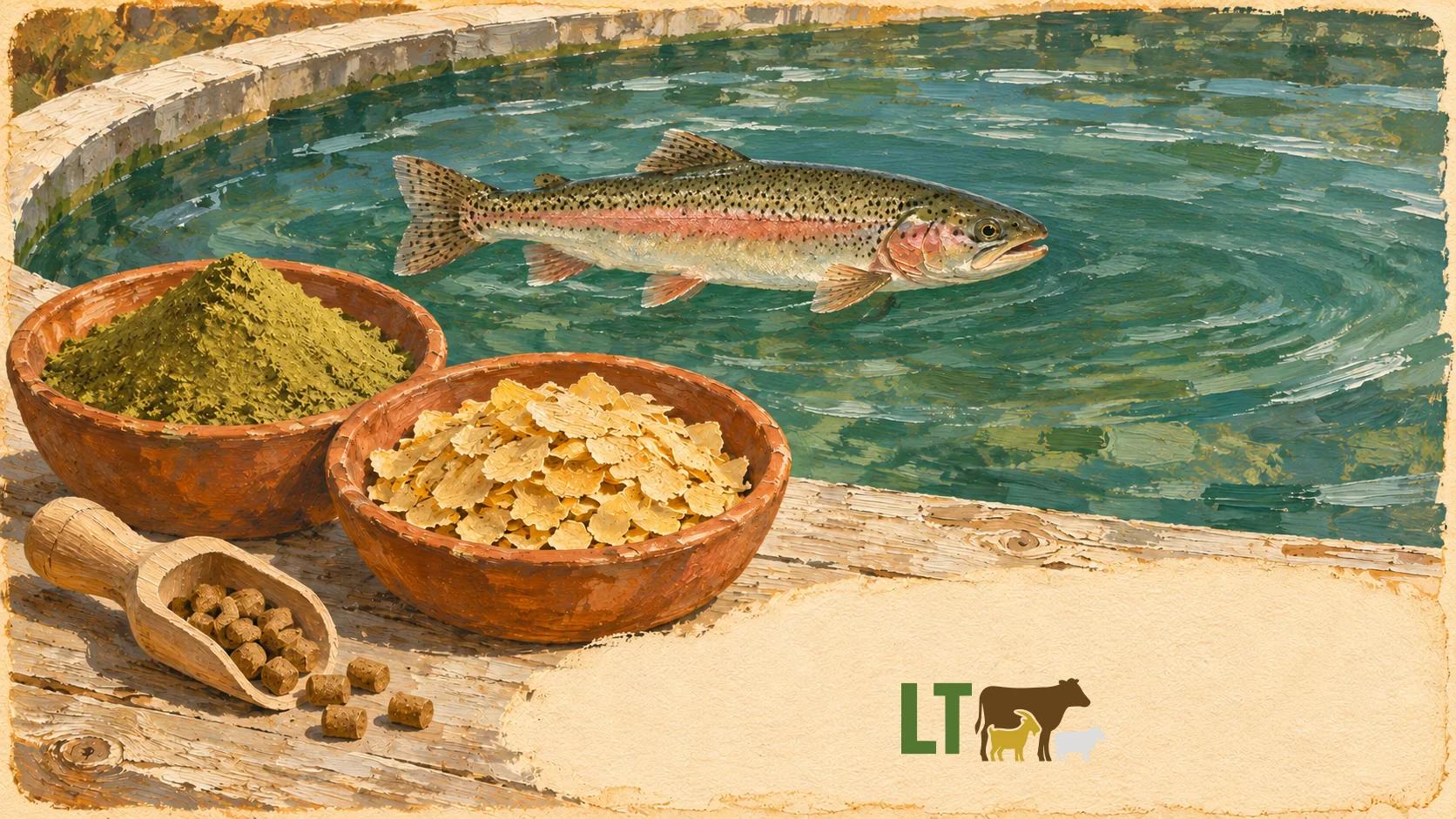
Fishmeal and fish oil do different work
Fishmeal and fish oil often appear together on an aquafeed ingredient list. They come from fish, but they contribute different things to a formulated diet. Fishmeal supplies protein and other nutrients. Fish oil supplies fats, including important omega-3 fatty acids.
The UC Santa Cruz account published November 12 describes work aimed at replacing both. The team combined two kinds of microalgae—microscopic organisms used to produce different feed ingredients—with canola oil and the rest of the diet.
That combination matters. Removing a marine ingredient is only the first half of the task. The trout must still receive a useful balance of nutrients in pellets it will eat.
An oil byproduct gets a second job
California Sea Grant’s October 13 interview explains where one ingredient begins. A producer grows microalgae and extracts oil for nutritional supplements. The remaining material is rich in protein.
That leftover biomass, meaning the material made by the organism, can become part of trout feed. It gives an ingredient that has already served one industry another use.
The other microalgal ingredient helps fill the oil role. It supplies DHA, one type of omega-3 fat. Canola oil contributes to the fat blend, while other ingredients complete the formulation.
This is a carefully combined feed, rather than a bowl of algae replacing the entire ration. The study diets still contained other plant and land-animal ingredients, along with added nutrients.
The form of an ingredient can change the result
The original paper, published October 16, compared four diets over 84 days in juvenile rainbow trout. One retained fishmeal and fish oil. The alternatives replaced some or all of those two ingredients.
The complete-replacement diet using whole microalgal cells supported growth and feed conversion comparable to the reference diet. Feed conversion describes how much feed is needed for weight gain. The complete-replacement diet using extracted algal oil had lower growth than the reference.
That is a useful distinction for a feed team: the organism’s name alone does not describe the ingredient. Whole cells and extracted oil are different materials. A result from one form should not become a promise about the other.
The experiment tested complete formulations under its tank conditions. It supports a specific replacement approach, rather than a universal recipe for trout farms or other fish species.
From a promising mixture to usable pellets
An ingredient comparison also has to work beyond a small feed kitchen. The Sea Grant interview describes making feed at the Bozeman Fish Technology Center in Montana, then shipping it to a California state hatchery.
That account covers separate farm and hatchery trials. It should not be read as the same experiment as the paper’s tank study. Together, the accounts show why university work can move between nutrient formulation, feed manufacture and use in a production setting.
For a research director, this changes who belongs in the conversation. The nutrition team understands the intended nutrient balance. The people making the pellets understand processing. Hatchery staff know how the feed must fit the daily routine.
An ingredient can be promising while those practical questions still need work. The university’s November report explicitly identifies larger-scale evaluation and other byproducts as next steps.
Give the next feeding trial a useful shared view
Imagine a campus team comparing a conventional feed with a proposed microalgal formulation. A student notes that fish gather later around one feeding point. The team may want to revisit that meal before deciding what the observation means.
Time-stamped footage can bring the feeding routine into the discussion: when pellets arrived, how they spread and how the fish approached them. Feed samples and the team’s nutrition measurements answer the formulation question; the footage preserves the visible meal.
Livestock Technologies can help scope fixed views, capture, connectivity, storage and access to source footage around that feeding comparison. The study team can connect a meal with the diet it supplied and return to the same scene together.
Our technology overview, documented field work and university capabilities brief explain that infrastructure approach. Automatic intake estimates or nutrient measurements would require separate methods and testing.
For feed formulators
The protein ingredient was a Nannochloropsis oculata byproduct. The second ingredient was Schizochytrium, tested as whole cells or extracted oil. Those names identify the study materials; the practical story is the different jobs they performed.
What ingredient question should your next trial answer?
Bring the feed comparison and tank layout. We can discuss an observation scope that helps your university team revisit feeding time.
Discuss an aquaculture research project →