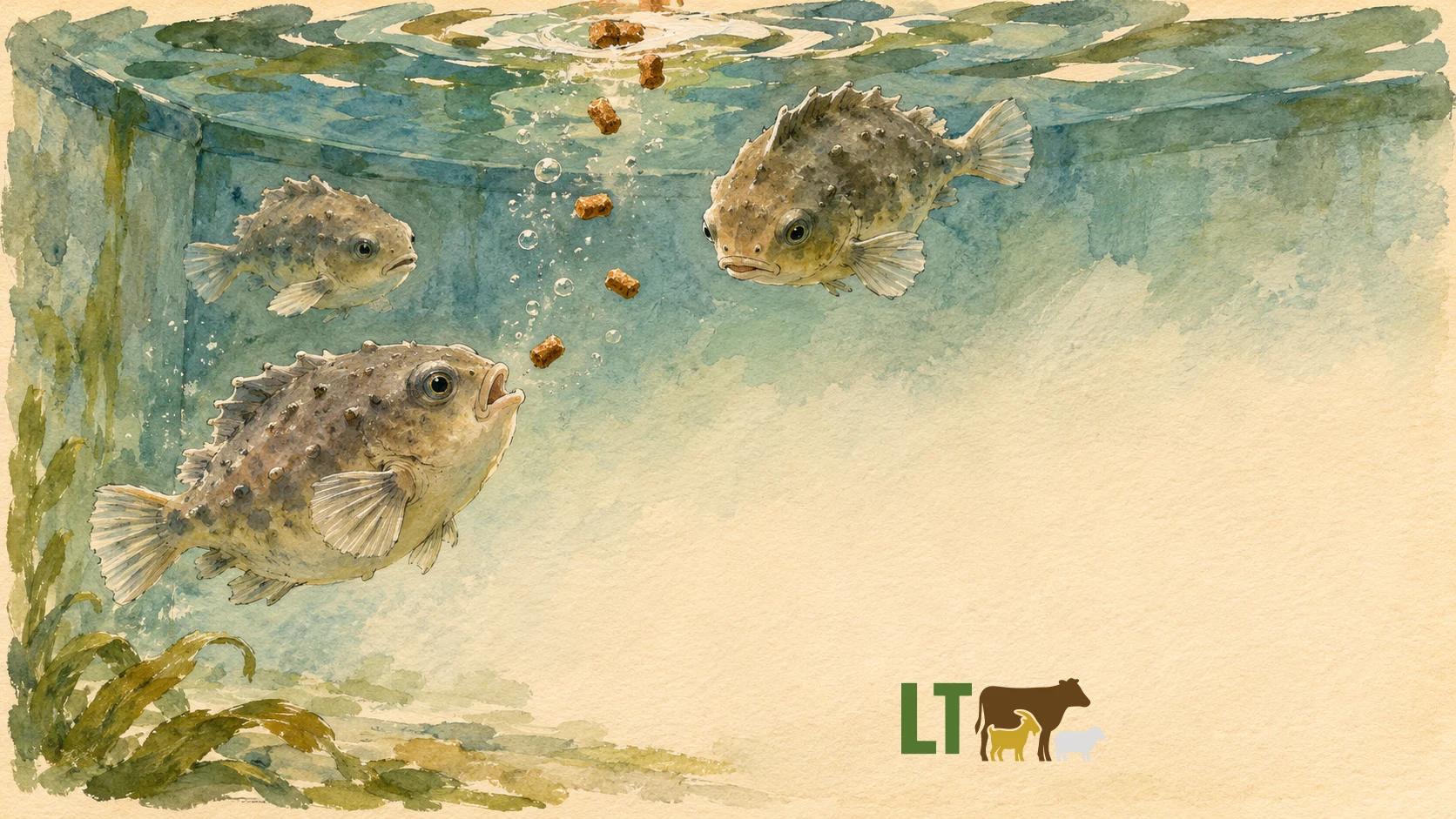
A small fish with a hatchery job
Lumpfish are rounded marine fish native to the Gulf of Maine. They interest New England aquaculture researchers because they can eat sea lice from salmon and trout. Raising the cleaner fish well is a research problem of its own.
The University of New Hampshire describes work on lumpfish nutrition, feeding, behavior and hatchery conditions. Its researchers have worked with regional salmon and steelhead farms. That makes the feeding question relevant to U.S. university teams, even though lumpfish may be unfamiliar to many livestock readers.
A hatchery needs fish suited to its next stage. The biggest possible fish is not always the only goal. A group whose members are closer in size may present a different management opportunity.
Two choices that sound like one
Meal frequency means how often feed arrives. Ration means the amount offered. A staff member can divide a planned daily ration into several meals without changing the total. Alternatively, staff can offer feed until the fish appear full, an approach called feeding to satiation.
Those choices can get blurred in conversation. “We fed more” might mean another meal, a larger portion or a different stopping point. Each changes the question a feeding trial can answer.
Imagine a campus team planning to replace two feeding visits with six. If it divides the same daily amount into six portions, it is testing a different routine from offering a full feeding at every visit. This is a hypothetical planning example, not a result from the study.
What the U.S. study found
A USDA Agricultural Research Service record describes a ten-week trial with juvenile lumpfish under hatchery conditions. Researchers compared regular feeding with feeding to satiation, alongside two or six meals a day. The record lists acceptance on November 11, 2026; it does not yet supply a journal publication date.
Regular feeding six times daily produced the greatest final weight. With satiation feeding, growth was similar at the two frequencies. Fish fed to satiation were also more alike in size.
The practical lesson is that meal number cannot be read on its own. The response depended on the feeding method. The public summary supports that comparison; it is not enough to prescribe a new ration for another hatchery.
Start with the fish you need to raise
A team interested in faster growth might ask a different question from one interested in a more even-sized group. Naming the goal first helps staff choose a comparison that makes sense.
UNH’s lumpfish research program places hatchery methods within the wider work of supporting U.S. cleaner-fish production. That context matters: the fish have a later role, and a feeding decision belongs within the rearing plan.
For the hypothetical campus team, a useful conversation would include the nutrition researcher and the staff who feed the tanks. They can settle what changes at each visit and what stays the same. That gives a student a clear explanation of the trial before the first portion reaches the water.
Make feeding time something the team can revisit
Some questions arise between sampling days. Did a portion fall in one place? Did fish approach immediately or gather later? A time-stamped tank view can preserve those visible moments for collaborators to discuss.
Livestock Technologies can help a university scope fixed views, recording, connectivity and access to original footage around its feeding routine. The team can return to a particular meal alongside its own feed and fish measurements. A visible approach to pellets should not be treated as a measured amount swallowed.
Our observation workflow, documented field work and university capabilities brief explain that infrastructure approach. For a hatchery project, the starting point is the feeding question and a view that can help answer it.
What feeding routine does your study need to see?
Bring the tank layout and the feeding comparison. We can discuss which views and recording windows would help your university team.
Discuss a hatchery research project →