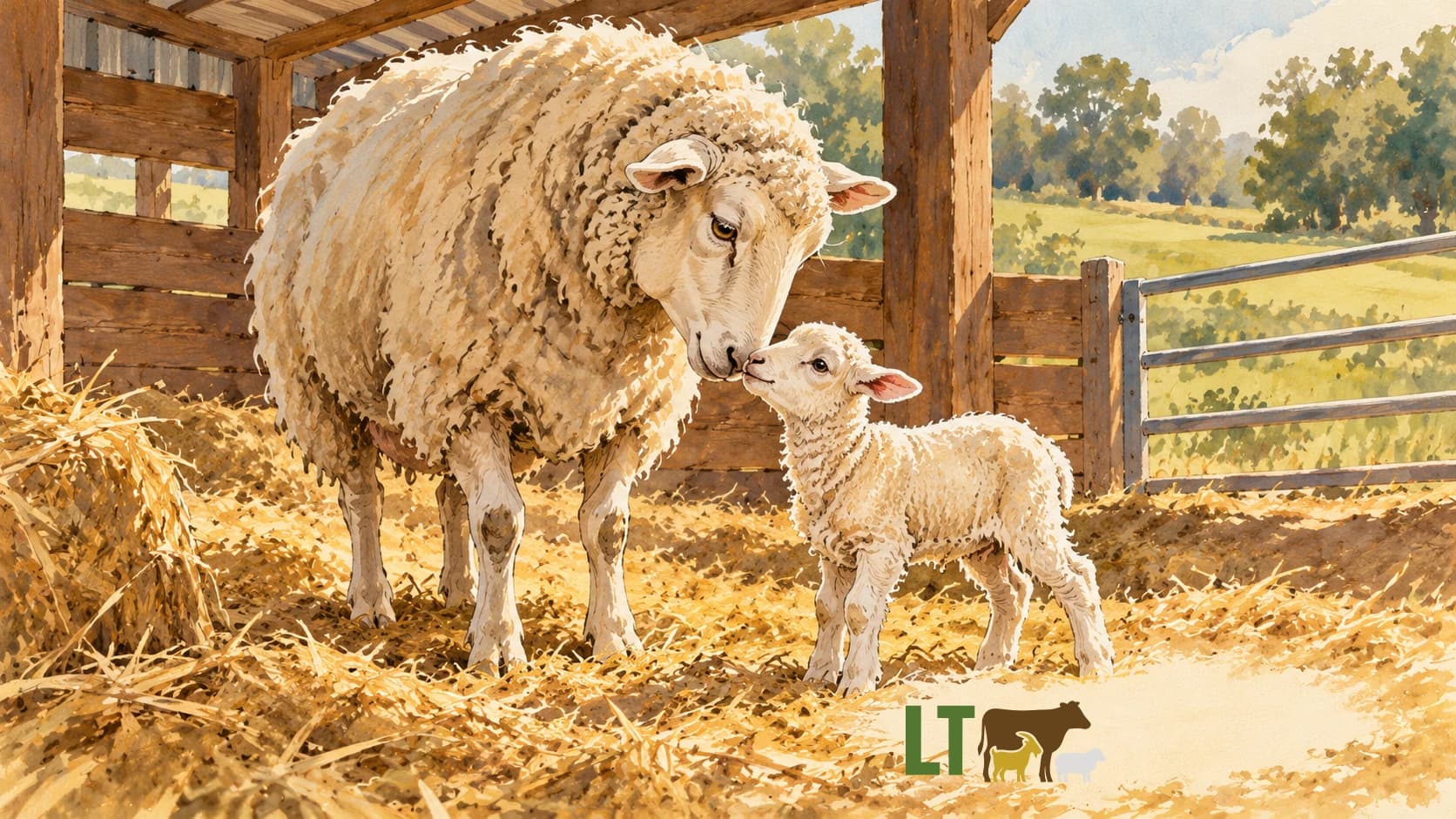
Start with the pair, not just the ewe
Early maternal care is an interaction. The ewe responds to her newborn, while the lamb begins its own attempts to stand and feed. A useful study asks how those actions fit together, rather than treating the mother as the only animal in the scene.
For university sheep teams, Livestock Technologies can discuss a custom observation scope around that interaction. Fixed views and access to source footage let colleagues return to the pair, alongside the university's own behavior scores and animal measurements.
Penn State Extension's lambing guidance describes a familiar early action: the mother licking her lamb dry. It also explains why lambing facilities can provide a space for the pair to bond. These everyday observations give a research question a concrete starting point.
A broad score can hide different behaviors
Kim Hay's doctoral research, dated September 29, 2026 in the University of Edinburgh archive, examined maternal behavior and lamb survival in UK sheep systems. Part of the work asked which actions lay behind a practical maternal assistance score.
In a small follow-up study, ewes described as having limited interest were more likely to lack positive behaviors. Ewes described as having no interest were more likely to headbutt or abandon their lambs. Those patterns point to different descriptions of maternal behavior.
The thesis suggests that refining the score could capture those differences more clearly. It is UK doctoral research, rather than a tested U.S. scoring standard. For a U.S. study team, it raises a useful question: does the overall rating preserve the behavior the project needs to understand?
Give the description enough detail to be useful
Imagine two short research summaries that both describe weak maternal attention. In one pair, the ewe shows little visible licking but remains beside the lamb. In the other, the ewe moves away when the lamb approaches.
This is a proposed example, not a result from the thesis or a company trial. The point is that the same broad summary could lead a reader to picture two different interactions. The footage lets collaborators discuss the actions themselves.
For example, a team studying positive contact may need to distinguish licking from simply standing nearby. A team studying rejection may be more interested in what happens when the lamb approaches. Each question gives the observation a purpose.
The care team's existing response plan takes priority whenever a lamb needs help. Research observations should fit that routine, with any assistance considered when interpreting the interaction.
The lambing setting belongs in the story
A sheltered pen and an open pasture offer different surroundings for the same pair. Penn State's guidance describes indoor and outdoor lambing and notes that weather, mothering ability and predator concerns influence that choice.
For researchers, the setting helps explain what the animals have an opportunity to do. A pair kept in a small bonding pen cannot show the same range of movement as a pair in a large grazing area. A calm moment in one space should therefore be described in its own context.
This does not make one setting the right answer for every study. It means the team should connect the behavior it wants to understand with the place where it occurs.
The bond also becomes a question beyond the barn
A current USDA Agricultural Research Service project in Idaho focuses on ewe–lamb relationships across remote grazing systems. Its plan includes location equipment for ewes and small signaling units for lambs, followed by work on how family groups stay together within the flock.
The project runs from August 2024 to August 2028. Its published objectives include examining links with lamb survival; the project page describes planned work, rather than a completed survival benefit.
That domestic research interest gives university teams a wider view of the question. Close observation around lambing can describe particular interactions. Following the family across grazing space addresses how the relationship unfolds later.
Build the view around the animal question
Our research observation workflow brings together fixed capture, connectivity, processing and access to source footage. A sheep project would define its own spaces, observations and data outputs. Any automatic maternal-behavior analysis would be separate work to develop and test.
The documented field work and university capabilities brief explain our infrastructure approach. The aim is to help collaborators return to the interaction that matters, so an overall score remains connected to the animals behind it.
Never lose an animal.
Which part of ewe–lamb bonding does your study need to see?
Bring the biological question and the lambing setting. We can discuss a practical camera and data scope with your research team.
Discuss a sheep research project →