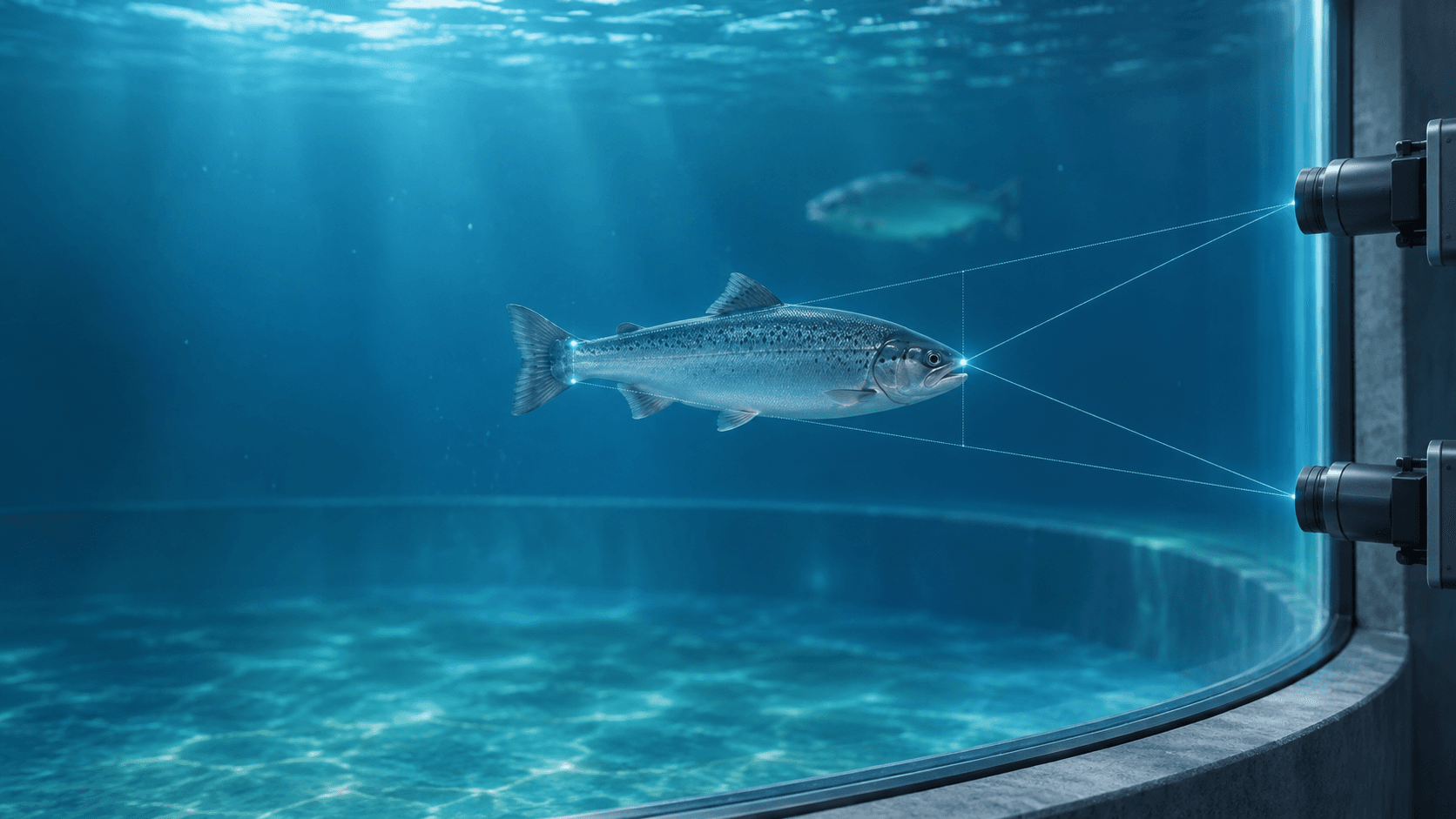
Why one camera view can make length hard to interpret
A fish is a long, flexible animal that can turn, bend, overlap another fish, or disappear partly behind the tank environment. In a single image, an apparent change in body length may come from the fish’s angle to the camera rather than from a real change in size.
Stereo vision uses two cameras viewing the same scene from slightly different positions. After calibration establishes how those views relate, software can match a point in one image with the corresponding point in the other and estimate its three-dimensional position. The distance between selected fish landmarks can then support a length estimate.
The 2026 Computers and Electronics in Agriculture paper, “FishKeypoints,” uses oriented boxes to locate fish whose bodies are not neatly horizontal, then identifies body points such as the mouth and caudal fin. Matching those landmarks across synchronized stereo views lets the researchers estimate position, motion, and length.
Read the FishKeypoints paper for its methods. The study reports trials at two commercial fish farms and compares estimates with other sensors and manual sampling; these are study-specific results, not a product claim by Livestock Technologies.
Four links in the measurement chain
A camera pair does not turn every visible fish into a dependable measurement automatically. Researchers need to understand the full chain from image to estimate.
- Calibration: characterize the lenses and the relationship between the left and right camera views underwater, where refraction and the housing can change the geometry.
- Landmarks: define the body points that count as the measurement endpoints, and check whether both are visible when the fish bends or overlaps another fish.
- Distance and pose: record the camera-to-fish range and orientation. A small image-location error can turn into a larger depth or length error farther from the cameras.
- Reference: compare estimates with a separately collected measure, such as manual sampling or another sensor, and describe how the reference itself was obtained.
“Calibration” is the process of measuring how a camera system maps the real scene into image coordinates. “Keypoints” are named points on an object—here, fish anatomy—that help the system describe position and shape more precisely than a box around the whole animal.
What the 2026 field study can—and cannot—answer
The paper matters because it evaluates a stereo workflow with footage from commercial aquaculture settings rather than relying only on tidy laboratory images. It also combines multiple checks: fish-length estimates are compared with reference information from other sensors and manual sampling.
For a research team, the practical lesson is to report the conditions with the number: species and size range, camera geometry, working distance, water clarity, fish density, visibility of the selected landmarks, and the reference method. A result from one pair of cameras and two farm trials should not be read as an accuracy guarantee for a different species, tank, camera placement, or production system.
The authors state that they do not have permission to share the study data. That limits independent reuse of the underlying footage. A new project should therefore plan its own data access, reference-sampling protocol, and quality checks rather than assume the paper’s dataset is available for replication.
A concrete way to plan a fish-length study
Imagine a team wants to compare the length distribution of fish in two tank sections over several weeks. Before collecting video, the team could choose its fish-length definition, mark which body points count, fix a camera range, and decide how often a subset of fish will receive a manual reference measurement.
Then the team can report more than a single average error: how many fish were measurable, how often one landmark was hidden, whether error changed with distance or body angle, and whether performance differed between size groups. Those details help another researcher decide whether the method fits a new question.
The camera record is an observation source. It does not replace animal handling, husbandry, water-quality measurements, or the study’s chosen reference method. Those remain part of the research protocol and animal-care plan.
How this relates to Livestock Technologies’ documented work
At Tuskegee University, the company documents fixed RGB and thermal camera views around four cattle research pens, solar-powered field nodes, wireless backhaul, and on-site processing and storage. Researchers can review the field-results page and the deployment report to see what is installed and how that cattle research environment is organized.
The FishKeypoints paper is independent aquaculture research. It does not establish that Livestock Technologies has underwater cameras, fish-length software, or validated systems for fish. For university teams, the ungated research capabilities brief explains the company’s demonstrated scope and provides a useful starting point for a project conversation.
Never lose an animal.
Bring the research question and the reference measure.
If your university team is scoping animal-observation infrastructure, share the species, outcome, field conditions, and how you plan to verify it. Livestock Technologies can discuss the documented platform and determine whether a project fits its demonstrated scope.
Discuss a university research project →