Continuous Livestock Monitoring With Reviewable Evidence
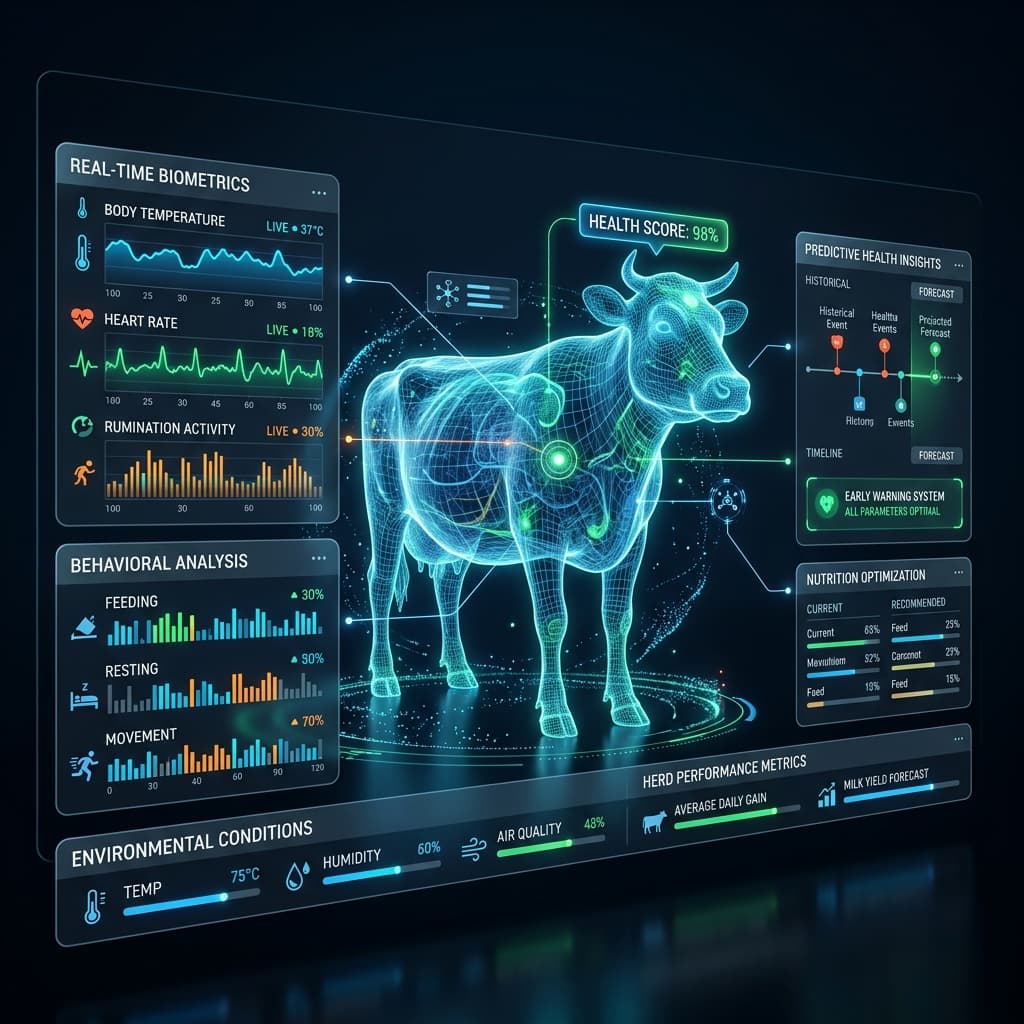
Continuous monitoring is useful when it gives feedlot teams a clear path from a camera observation to the original evidence, the operating context, the responsible reviewer, and a recorded resolution. Livestock Technologies builds that path with fixed cameras, on-site compute, and reviewable exception queues.
A continuous evidence workflow
A crew cannot watch every camera stream at once. The system organizes defined observation windows and preserves the frames behind each queued event, so a reviewer can move directly to the relevant place and time.
Capture
Fixed cameras preserve time-stamped digital and thermal views across defined pens, gates, bunks, water points, alleys, and handling areas.
Process on site
Local compute associates observations with camera, time, mapped zone, quality state, and the relevant operating window.
Build the exception queue
Events that meet a site-defined review rule are packaged with source frames, location, timing, visibility, and supporting context.
Review and resolve
A responsible person opens the original evidence, compares it with operational records and direct observations, and records the outcome.
Day-and-night digital and thermal evidence
Livestock Technologies deploys fixed digital and thermal camera channels around defined feedlot views. Digital imagery preserves visible scene detail, while thermal imagery provides a parallel view of surface-temperature patterns. Timestamps, camera identity, mapped zones, and capture-quality states keep both channels anchored to the same operating record.
The evidence packet retains the original view instead of reducing an event to a score. Reviewers can inspect what was visible, which channel contributed, whether the view was obstructed, and what changed across the selected window.
What arrives in a review queue
- Source evidence: Original digital and thermal frames with timestamps.
- Location: Camera, pen, gate, alley, bunk, water point, or controlled handling area.
- Quality state: Visibility, obstruction, missing interval, and calibration context.
- Operational context: The relevant record, cohort, expected state, or review window.
- Review status: Owner, notes, disposition, and resolution history.
Exception queues that point back to evidence
An exception queue should answer a practical question: what deserves review, why is it here, and what evidence supports it? Site-defined rules can organize candidate inventory mismatches, movement windows, zone-activity changes, or capture-quality problems without hiding uncertainty.
| Review workflow | Camera evidence | Operating context |
|---|---|---|
| Inventory and movement | Presence, direction of travel, and activity around a defined gate, alley, or pen boundary | Receiving, processing, transfer, hospital, return, and shipping records |
| Bunk and water zones | Visit timing, duration, occupancy, and visible change across a defined review window | Feed delivery, ration, weather, water checks, and crew observations |
| Visibility and coverage | Missing intervals, obstruction, lighting change, blur, or a camera view outside its calibrated area | Camera health, network state, maintenance history, and the site coverage map |
| Individual review windows | A time-and-place sequence linked to an operational identifier or controlled chute passage | Tag, manifest, chute record, cohort, and reviewer notes |
On-site compute keeps the workflow close to operations
On-site processing connects camera streams with a mapped model of pens, gates, bunks, water points, and handling areas. The site model helps locate observations, define coverage, and retrieve events by place and time.
Local compute also supports site-controlled data flow. Deployment plans can define authorized access, retention, backup, export, maintenance, and remote-support connections around the operator's requirements.
Human review closes the evidence loop
The reviewer compares camera evidence with direct observation and the relevant system of record, then records whether the event was explained, escalated, or left unresolved. Those outcomes become the basis for measuring queue usefulness, coverage, review time, and recurring causes.
Measure the complete review workflow
A measurable deployment should measure more than the number of queued events. Useful measures include the share of time and space covered, missing views, exceptions per operating window, reviewer agreement, review time, resolved causes, repeated issues, and staff workload.
Research on livestock AI emphasizes the full evidence chain—from sensing and ground truth through deployment and decision use. A peer-reviewed livestock AI review provides broader context, while a University of Nebraska–Lincoln field study illustrates prospective evaluation of remote livestock sensing under feedlot conditions.
Start with one review workflow
Make continuous camera evidence operational
Map the decision, authoritative records, camera coverage, exception rule, review owner, and acceptance criteria for a bounded feedlot assessment.
Bring us the livestock workflow or research question.
We'll help define the smallest useful deployment, the evidence it should produce, and how your team will evaluate fit.